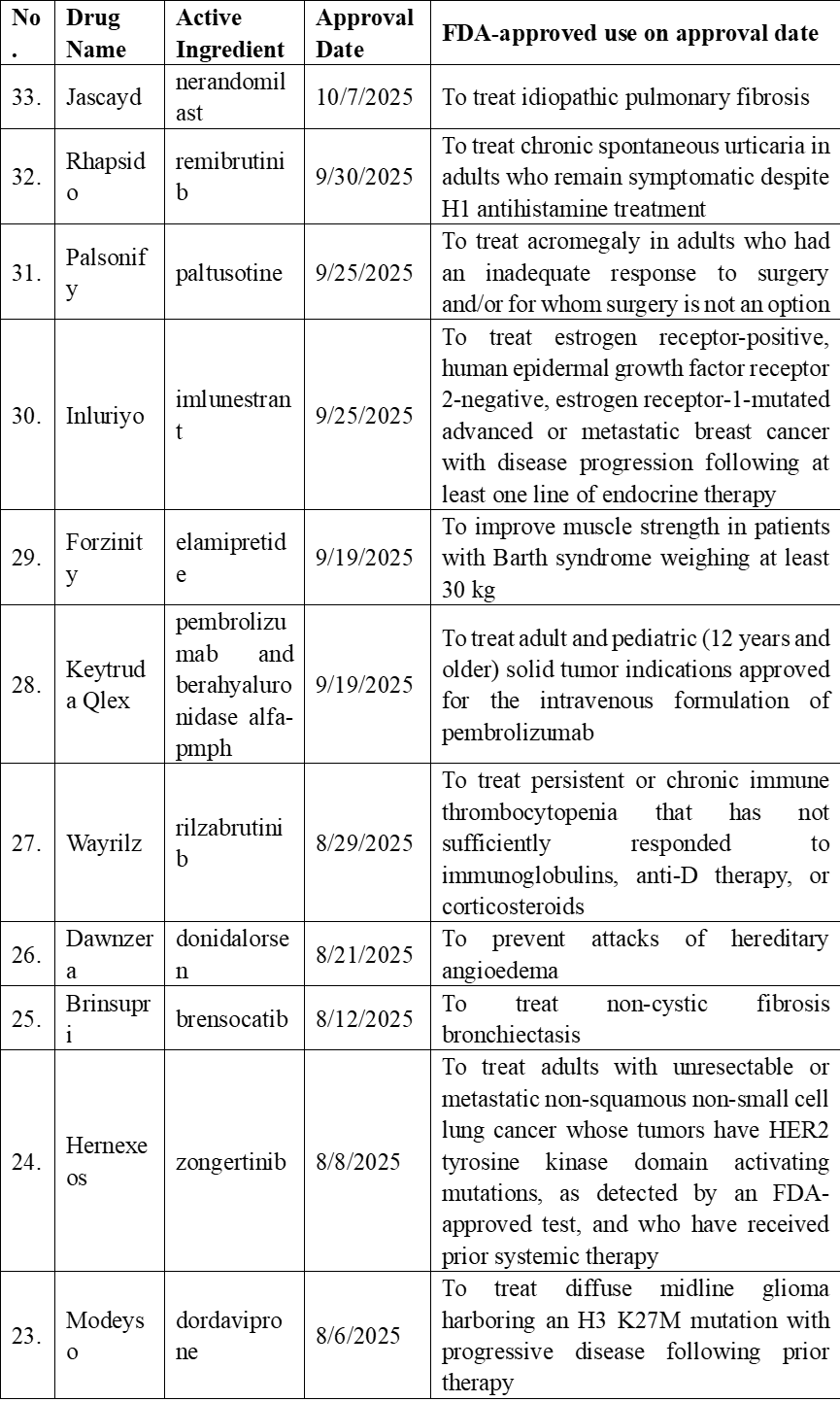
As of October 7, 2025, the U.S. FDA has approved 33 new drugs, spanning a broad spectrum from rare genetic diseases to common cancers. This marks the continued maturation and wider adoption of precision medicine, gene-targeted therapies, and immunomodulatory treatments. These drugs are not only innovative in their mechanisms but also bring new hope to areas with significant unmet clinical needs. This article provides a systematic review and analysis of these newly FDA-approved drugs.
In the field of oncology, several approvals further reinforce the concept of "precision therapy." For example, Hernexeos (zongertinib) targets HER2 tyrosine kinase domain mutations in non-small cell lung cancer (NSCLC), Zegfrovy (sunvozertinib) targets EGFR exon 20 insertion mutations in NSCLC, and Ibtrozi (taletrectinib) is used for ROS1-positive lung cancer; all exemplify biomarker-based individualized treatment strategies. Additionally, Lynozyfic (linvoseltamab-gcpt), a bispecific antibody, provides a new immunotherapy option for patients with heavily pretreated multiple myeloma. Emrelis (telisotuzumab vedotin-tllv) targets c-Met overexpression, expanding the application of Antibody-Drug Conjugates (ADCs) in lung cancer. Notably, Inluriyo (imlunestrant), a treatment option for estrogen receptor-mutated advanced breast cancer, demonstrates progress in strategies following endocrine therapy resistance. The combination therapy Avmapki Fakzynja Co-Pack (avutometinib with defactinib) for KRAS-mutant low-grade serous ovarian cancer represents a significant breakthrough for this difficult-to-treat subtype after many years. The concentrated launch of these drugs not only enriches the therapeutic arsenal but also promotes the routine clinical use of companion diagnostics and molecular subtyping.
Significant progress has also been made in rare and genetic diseases. Forzinity (elamipretide) becomes the first-in-class therapy to improve muscle strength in patients with Barth syndrome, offering targeted intervention for this extremely rare mitochondrial disorder. Sephience (sepiapterin), by targeting a specific type of phenylketonuria, illustrates the shift from dietary control to targeted pharmaceutical intervention for metabolic diseases. In the treatment of neurofibromatosis type 1, Gomekli (mirdametinib) offers the possibility of pharmacological control for patients with inoperable plexiform neurofibromas. Furthermore, multiple drugs focus on the prevention and acute treatment of hereditary angioedema (HAE), such as Dawnzera (donidalorsen) and Andembry (garadacimab-gxii) for prevention, and Ekterly (sebetralstat) for acute attacks, reflecting the diversification of treatment options and refinement of patient management strategies in this area.
In autoimmune and inflammatory diseases, drug mechanisms are increasingly diverse. Rhapsido (remibrutinib), a BTK inhibitor for chronic spontaneous urticaria inadequately controlled by H1-antihistamines, highlights the central role of B-cell and mast cell pathways. Wayrilz (rilzabrutinib), also a BTK inhibitor, provides a new mechanism drug for patients with refractory immune thrombocytopenia. Anzupgo (delgocitinib), a topical JAK inhibitor for moderate-to-severe chronic hand eczema, expands the application of JAK inhibitors in dermatology. Imaavy (nipocalimab-aahu), by targeting FcRn to reduce pathogenic IgG antibody levels, brings new hope to patients with generalized myasthenia gravis.
The anti-infective field also has notable highlights. Blujepa (gepotidacin), a novel topoisomerase inhibitor for uncomplicated urinary tract infections, offers a unique mechanism to help address the growing challenge of antibiotic resistance. Enflonsia (clesrovimab-cfor), a long-acting monoclonal antibody for preventing lower respiratory tract disease caused by RSV in infants and toddlers, is an important addition to RSV prevention following vaccines.
Additionally, several drugs address unmet needs in specialized areas. Jascayd (nerandomilast) is a new option for treating Idiopathic Pulmonary Fibrosis; Palsonify (paltusotine) offers an oral option for acromegaly patients with an inadequate response to surgery; Modeyso (dordaviprone), targeting H3 K27M-mutant diffuse midline glioma, represents significant progress in treating pediatric and adolescent brain tumors; Romvimza (vimseltinib) for symptomatic Tenosynovial Giant Cell Tumor provides a pharmacological option for patients where surgery is not feasible; Vanrafia (atrasentan) slows the progression of IgA nephropathy by reducing proteinuria; Qfitlia (fitusiran), an RNAi therapy for preventing bleeding episodes in hemophilia A or B, represents a major breakthrough in non-factor replacement therapies.
In ophthalmology and pain management, Vizz (aceclidine) offers a pharmacological treatment option for presbyopia. Tryptyr (acoltremon) targets both signs and symptoms of dry eye disease, illustrating a shift from traditional artificial tears to interventions targeting the underlying pathology. Journavx (suzetrigine) provides a treatment for moderate-to-severe acute pain, enriching pain management strategies.
Notably, some drugs feature innovations in formulation and administration. Keytruda Qlex (pembrolizumab with berahyalumnidase alfa-pmph), a subcutaneous formulation, offers more convenient administration of pembrolizumab, improving patient compliance and healthcare resource utilization.
Overall, the new drugs approved by the FDA in 2025 so far reveal several notable trends: first, cancer treatment continues to advance in precision, immunotherapy, and combination strategies; second, rare disease drug development is thriving, with many previously untreatable conditions receiving their first therapies; third, drug mechanisms of action are increasingly diverse, encompassing monoclonal antibodies, small molecule inhibitors, RNAi, and cell therapy preparatory regimens (e.g., Grafapex (treosulfan with fludarabine) for conditioning prior to hematopoietic stem cell transplantation), reflecting a continuous enrichment of technology platforms; fourth, increased focus on drugs for pediatric, geriatric, and chronic disease management. These advances reflect not only scientific breakthroughs in pharmaceutical R&D but also the collaborative efforts of regulators and industry in addressing complex disease challenges. As these new drugs gradually enter clinical practice, they will collectively shape the treatment landscape in the coming years, offering more effective, safer, and more convenient treatment options for patients worldwide, continually pushing the boundaries of human health forward.
Source: FDA