Adeno-associated virus (AAV) has become an important vector platform for gene therapy, but manufacturing sufficient quantities of high-quality vectors remains a major challenge as programs move from early development toward larger-scale clinical and commercial production.
A recent collaboration between Minaris and Asimov highlights one direction the industry is exploring: stable producer cell lines designed specifically for scalable AAV manufacturing.
On September 24, 2026, Minaris and Asimov announced a partnership to integrate Minaris’ OXGENE technology into Asimov’s AAV Edge producer cell line platform. The collaboration aims to develop higher-performing producer cell lines with improved manufacturing titers and product quality.
The development reflects a broader question facing the gene therapy industry: how can AAV manufacturing become more scalable, consistent and suitable for long-term production?
Why Transient AAV Production Can Become Challenging at Scale
Many AAV manufacturing processes rely on transient transfection.
In a typical transient production workflow, producer cells are expanded and then transfected with plasmids carrying the genetic components required for vector production.
This approach offers flexibility during research and early process development, but scaling it for larger manufacturing campaigns can introduce additional complexity.
According to Minaris and Asimov, many AAV programs still require multiple GMP-grade plasmids for every production batch. This can increase manufacturing costs, create additional supply-chain requirements and make large-scale production more difficult.
Batch-to-batch consistency also becomes increasingly important as a gene therapy program advances toward late-stage development and commercialization.
As production volume increases, manufacturers must control not only vector yield but also raw materials, cell performance, process parameters and product quality across repeated manufacturing runs.
Stable Producer Cell Lines Offer a Different Manufacturing Strategy
Stable producer cell lines are being developed as an alternative approach.
Instead of introducing all required genetic components through transient transfection during every manufacturing batch, stable systems integrate key production elements into a defined producer cell line.
Asimov's AAV Edge Stable Producer System is designed around high-titer clonal producer cell lines. The company first introduced its stable AAV producer cell line platform in 2025 as part of an effort to reduce reliance on transfection-based manufacturing.
The new collaboration will add OXGENE technology to this development platform, with the goal of further improving producer cell line performance.
Stable production does not automatically eliminate all challenges associated with AAV manufacturing. Developing robust producer cell lines requires careful genetic engineering, clone selection, characterization and process development.
However, if successfully established, the approach may simplify certain production steps and support more standardized manufacturing workflows.
Cell Line Performance Becomes Part of the Manufacturing Platform
The shift toward stable producer systems also places greater emphasis on the producer cell line itself.
For viral vector manufacturing, cells are not simply a raw material. Their growth characteristics, genetic stability, productivity and response to culture conditions can directly influence manufacturing performance.
This makes cell line development closely connected with upstream process development.
A scalable production strategy therefore needs to consider the complete workflow:
Producer Cell Line → Cell Expansion → Upstream Culture → Vector Production → Harvest → Purification → Quality Control
As programs progress, each stage must be sufficiently controlled to support repeatable manufacturing.
Cell expansion and upstream culture are particularly important because the production process must generate a consistent population of healthy cells before vector production begins.
Scaling AAV Manufacturing Is More Than Increasing Culture Volume
Moving from research-scale AAV production to clinical or commercial manufacturing is not simply a matter of using a larger culture vessel.
Manufacturers must maintain consistent conditions as cell numbers increase.
This includes controlling factors such as:
cell density and viability;
culture conditions;
media and raw materials;
timing of process steps;
contamination control;
material transfer;
harvest procedures;
batch-to-batch consistency.
At larger scales, operational complexity also increases.
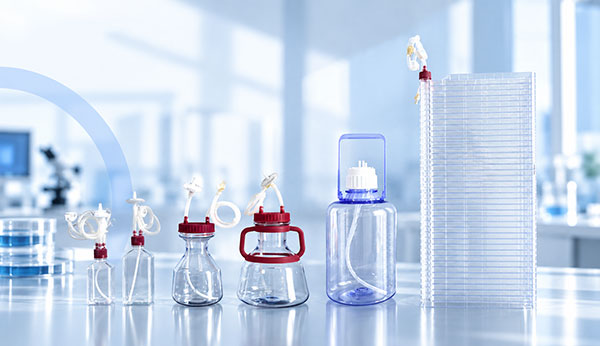
For this reason, scalable cell culture platforms, single-use technologies and closed processing strategies are increasingly important parts of modern biomanufacturing.
They can help reduce unnecessary open handling and support more controlled material transfer as processes move between cell expansion, production and harvest.
From Process Flexibility to Manufacturing Consistency
Transient transfection will continue to play an important role in AAV development, particularly where flexibility and rapid process development are required.
Stable producer systems represent a different manufacturing strategy rather than a universal replacement.
Their potential advantage becomes particularly relevant when manufacturers need to repeatedly produce larger quantities of the same vector while controlling cost, supply requirements and process variability.
The Minaris-Asimov collaboration therefore reflects a wider evolution in gene therapy manufacturing.
As AAV programs move toward later-stage clinical development and commercialization, manufacturing strategies are increasingly being designed around scalability, process consistency and long-term production readiness, rather than vector yield alone.
Building More Scalable AAV Manufacturing Platforms
The next stage of AAV manufacturing development is likely to involve improvements across multiple parts of the process.
Producer cell engineering, upstream cell culture, process automation, single-use systems, closed processing, analytical control and downstream purification all contribute to manufacturing performance.
Stable producer cell lines are one part of this larger transition.
For gene therapy developers, the challenge is increasingly to build manufacturing platforms that can move from development into larger-scale production without introducing excessive process complexity or variability.
The latest collaboration between Minaris and Asimov provides another example of how the industry is addressing this challenge—by engineering the production system itself for greater scalability and consistency.
Source: Minaris and Asimov, Minaris and Asimov Partner to Advance AAV Manufacturing with OXGENE Technology, September 24, 2026.










