Rabies remains one of the deadliest viral diseases worldwide, causing thousands of deaths each year, especially in developing countries. As global demand for safer and higher-yield vaccines continues to increase, vaccine manufacturers are seeking more efficient upstream culture systems. Among the available technologies, the Cell Factory has become an important solution for large-scale rabies vaccine production.
Compared with traditional roller bottles and static culture systems, modern Cell Factory platforms provide higher cell expansion efficiency, better scalability, and lower contamination risk. Today, many vaccine manufacturers use Multilayer Cell Factory systems to support Vero cell culture and viral propagation in rabies vaccine manufacturing.
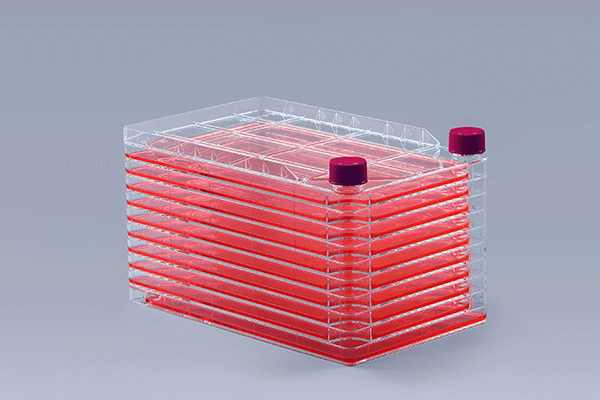
Cell Factory 10 Layers TC-treated
Why Rabies Vaccine Production Requires Efficient Cell Expansion
Rabies vaccines are commonly produced using adherent cell lines such as:
Vero cells
BHK-21 cells
Primary chick embryo cells
Among these, Vero cells are widely adopted because of their stability, safety profile, and suitability for viral vaccine production.
Since adherent cells require a large growth surface area, manufacturers need culture systems capable of supporting:
High-density cell growth
Consistent nutrient distribution
Stable environmental conditions
Large-scale virus production
Traditional culture vessels often struggle to meet industrial-scale demands efficiently. This is why the Cell Factory has become increasingly important in vaccine manufacturing facilities.
Advantages of Using Cell Factory Systems for Rabies Vaccine Manufacturing
High Surface Area for Cell Growth
A Multilayer Cell Factory provides a significantly larger culture surface area compared with standard cell culture flasks.
For example:
1-layer systems are suitable for process development
10-layer systems support pilot-scale production
40-layer systems are commonly used in industrial manufacturing
This large growth area enables efficient Vero cell expansion while reducing the number of individual handling operations.
Improved Production Scalability
Scalability is critical in rabies vaccine manufacturing.
A Cell Factory allows manufacturers to scale production from laboratory research to commercial manufacturing while maintaining similar culture conditions.
Benefits include:
Easier process transfer
Reduced process variability
Simplified validation
Consistent production performance
Because the design remains standardized across different layer configurations, scale-up becomes more manageable for vaccine manufacturers.
Reduced Contamination Risk
Contamination control is essential in vaccine production environments.
Compared with handling hundreds of roller bottles, a Multilayer Cell Factory reduces:
Open handling steps
Manual operations
Media transfer frequency
Closed or semi-closed systems help minimize microbial contamination risk during upstream processing.
In GMP manufacturing environments, reducing contamination opportunities can significantly improve batch success rates.
Compatibility with Vero Cell Culture
Vero cells are highly adherent and widely used for rabies virus propagation.
Modern Cell Factory systems are typically designed with:
TC-treated surfaces
Excellent cell attachment performance
Uniform surface hydrophilicity
High optical clarity
These characteristics help support:
Rapid Vero cell attachment
Stable cell morphology
Efficient viral infection
Consistent vaccine yield
Surface-treated Cell Factory products are especially important for maintaining reliable vaccine production performance.
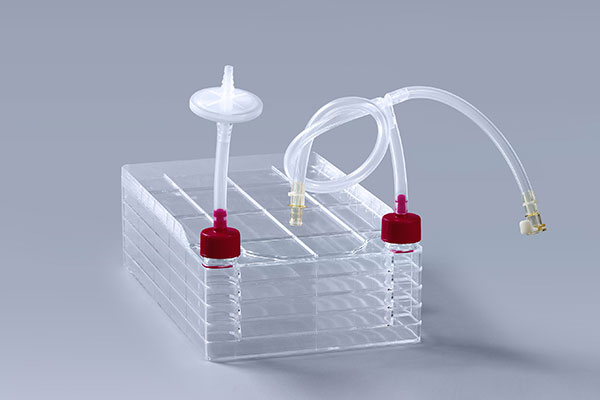
Closed System Cell Factory with Tube
Space-Saving Design for Manufacturing Facilities
Facility space efficiency is another important consideration.
A Multilayer Cell Factory provides a compact footprint while offering large culture areas. This allows manufacturers to:
Increase production capacity
Optimize cleanroom space
Reduce incubator occupancy
Improve workflow organization
For vaccine manufacturers operating under strict cleanroom requirements, space optimization can directly reduce operational costs.
Simplified Media Exchange and Harvesting
Modern Cell Factory systems are designed to simplify liquid handling operations.
Features often include:
Wide tubing compatibility
Multiple port configurations
Easy media exchange
Efficient harvesting procedures
These features improve process efficiency during:
Cell seeding
Media replacement
Virus infection
Viral harvest
Automated or semi-automated handling can further reduce labor intensity in large-scale rabies vaccine production.
Single-Use Technology Advantages
Single-use Cell Factory systems are becoming increasingly popular in vaccine manufacturing.
Advantages include:
No cleaning validation
Reduced cross-contamination risk
Faster production turnaround
Lower water and chemical consumption
Simplified GMP compliance
Disposable Multilayer Cell Factory systems also help manufacturers respond more rapidly to sudden vaccine demand increases.
Important Factors When Selecting a Cell Factory Supplier
When choosing a Cell Factory supplier for rabies vaccine manufacturing, buyers should evaluate:
Surface treatment consistency
Sterility assurance
Material quality
Leak-proof performance
Layer uniformity
Gamma sterilization validation
Production cleanroom standards
Reliable suppliers can provide:
ISO-certified manufacturing
Batch traceability
Quality inspection reports
OEM customization support
Consistent product quality is essential for stable vaccine production performance.
Future Trends in Rabies Vaccine Manufacturing
As global vaccine demand grows, manufacturers continue to improve upstream production efficiency.
Future trends include:
Automated liquid handling integration
Closed-system processing
High-efficiency surface modifications
Smart manufacturing systems
Larger-scale Multilayer Cell Factory platforms
These innovations will help vaccine manufacturers achieve higher productivity while maintaining strict quality standards.
Conclusion
The Cell Factory has become an essential tool in modern rabies vaccine manufacturing. Its large culture surface area, scalability, contamination control advantages, and compatibility with Vero cell culture make it highly suitable for industrial vaccine production.
Compared with traditional culture systems, the Multilayer Cell Factory offers improved operational efficiency, reduced labor requirements, and more consistent manufacturing performance.
As vaccine manufacturers continue expanding global production capacity, advanced Cell Factory systems will play an increasingly important role in supporting safe and efficient rabies vaccine manufacturing.










