In biological laboratories, PETG media bottles have become the ideal choice for storing various reagents due to their excellent transparency, temperature resistance, and chemical stability. Whether for cell culture, molecular biology experiments, or clinical testing, these bottles play an indispensable role. With numerous options available in the market, how should one select the appropriate specifications?
Material Selection: PETG vs. PET Performance Comparison
PETG media bottles are primarily made from two materials: PETG and PET. Both offer outstanding transparency (light transmittance >90%) and temperature resistance (withstanding temperatures from -80°C to 121°C). PETG demonstrates superior barrier properties, with a water vapor transmission rate at least 30% lower than PET, providing better protection for moisture-sensitive reagents such as enzyme preparations and certain cryopreservation solutions. For solutions requiring long-term storage or higher stability, PETG media bottles are the preferred choice.
Specifications Explained: From Micro to Bulk Volumes
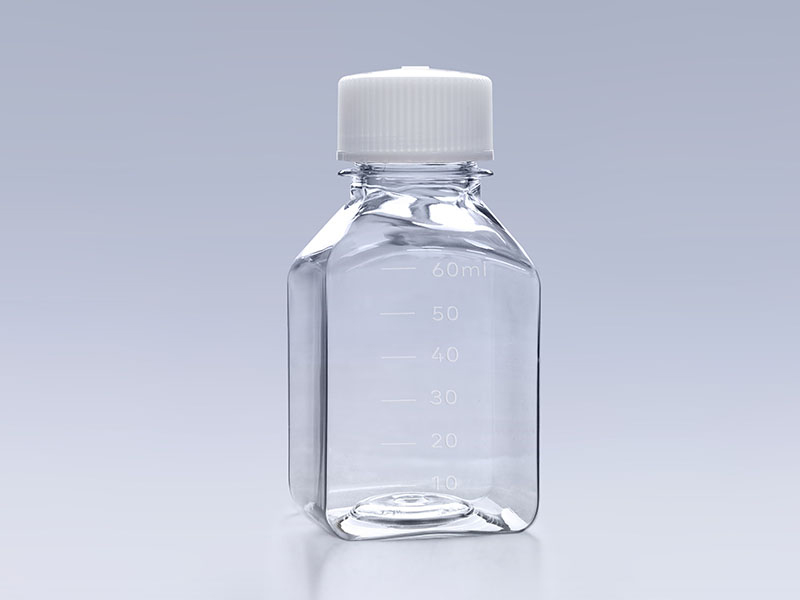
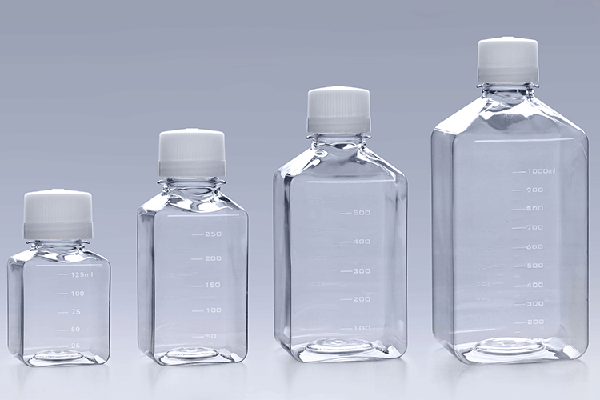
The specifications of PETG media bottles are carefully designed to meet experimental needs, with common capacities including 5ml, 10ml, 30ml, 60ml, 125ml, 250ml, 500ml, and 1000ml. Small volumes (5-30ml) are suitable for storing precious samples or微量 reagents like antibody solutions and cytokines. Medium volumes (60-125ml) are commonly used for preparing culture media and buffers. Large volumes (250ml and above) are ideal for bulk reagent storage and distribution. Notably, the square-shaped bottle design not only saves storage space but also conforms to ergonomic principles, enabling single-handed operation.
Functional Expansion: Versatile Cap Applications
To meet diverse experimental requirements, PETG media bottles can be paired with various functional caps:
Standard caps: Provide basic airtight protection for routine storage
Three-port caps: Facilitate tubing connections for sterile liquid transfer
Filter caps: Allow gas exchange during storage, particularly suitable for cell culture media requiring aeration
These accessories significantly expand the application scenarios of PETG media bottles, transforming them from simple storage containers into multifunctional laboratory tools.
Application Scenarios: Matching Experimental Needs
Different specifications of PETG media bottles serve distinct purposes in the laboratory:
Cell culture: 125-250ml bottles are typically used for storing culture media and serum
Molecular biology: 30-60ml bottles are suitable for storing various enzyme solutions and buffers
Biobanking: Large 500-1000ml bottles are used for bulk storage of cryopreservation solutions and reagents
When selecting PETG media bottles, in addition to capacity requirements, key indicators such as graduation accuracy (error margin
With continuous advancements in biotechnology, the design of PETG media bottles is constantly evolving. From material improvements to functional integration, these seemingly simple laboratory containers are becoming more professional and intelligent, providing reliable support for scientific research. Proper selection and use of PETG media bottles not only ensure reagent quality but also enhance experimental efficiency and reproducibility—a critical detail that no biological laboratory should overlook.










