Abstract
Diabetes mellitus (DM) is a complex metabolic disorder characterized by chronic hyperglycemia and associated complications such as cardiovascular disease, nephropathy, retinopathy, neuropathy, and chronic non-healing wounds. Current antidiabetic therapies offer only partial glycemic control and are limited by poor bioavailability, adverse effects, and an inability to prevent disease progression. Plant-derived exosome-like nanoparticles (PENPs) have emerged as a promising class of natural nanocarriers with excellent biocompatibility, low immunogenicity, and intrinsic multi-component bioactivity. However, few reviews have addressed recent progress in PENPs for DM therapy. To capture the recent developments in this area, this review provides a systematic synthesis of recent advances in PENPs for DM therapy, covering plant sources, extraction and purification methods, molecular compositions, and therapeutic mechanisms. Preclinical studies have demonstrated that PENPs can improve hyperglycemia, enhance insulin sensitivity, regulate hepatic lipid metabolism, and promote wound healing by modulating oxidative stress, inflammation, gut microbiota, glucose metabolism, and insulin signaling. Additionally, PENPs have been shown to promote angiogenesis via glycolytic reprogramming. Despite these promising findings, challenges including scalable isolation, standardized physicochemical characterization, and clinical translation remain. Future directions include engineering multifunctional PENPs, establishing Good Manufacturing Practice (GMP)-compliant production, and conducting clinical trials to facilitate their integration into precision therapeutics for diabetes management.
Keywords:
plant-derived exosome-like nanoparticles; diabetes and its complications; natural nanocarriers; nanobiomedicine; precision therapy
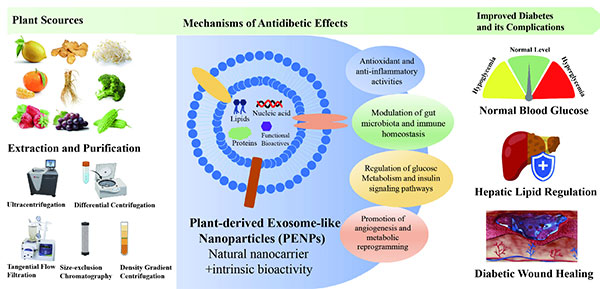
Graphical Abstract
1. Introduction
Diabetes mellitus (DM) has emerged as a critical global health burden [1]. According to the International Diabetes Federation (IDF, 2025) Atlas, approximately 589 million adults aged 20–79 worldwide are affected by diabetes, with this figure projected to increase to 853 million by 2050 [2]. The vast majority of these cases are classified as type 2 diabetes mellitus (T2DM). Chronic hyperglycemia associated with T2DM can lead to a range of debilitating complications, including cardiovascular disease, chronic kidney disease, retinopathy, neuropathy, and impaired wound healing [3]. These complications are fundamentally linked to pathological mechanisms such as insulin resistance, pancreatic β-cell dysfunction, and the dysregulation of the oxidative stress–inflammation axis [4,5]. Despite considerable advances in therapeutic approaches, current interventions remain limited in their ability to achieve sustained glycemic control, prevent long-term complications, and reverse disease progression [6,7].
Standard treatments for T2DM include insulin and metformin, alongside newer agents such as glucagon-like peptide-1 (GLP-1) receptor agonists and sodium–glucose cotransporter 2 inhibitors [8]. While these agents effectively reduce blood glucose levels, they are hindered by limitations including adverse side effects, low patient compliance, and the necessity for lifelong administration, despite offering ancillary benefits such as cardiovascular protection and weight loss [9,10]. For instance, metformin has limited oral bioavailability and is commonly associated with gastrointestinal disturbances [11,12], whereas insulin requires frequent injections, reducing patient adherence [13]. Although nanotechnology-based therapeutics have shown promise in enhancing delivery efficiency and targeting specificity, many synthetic nanomaterials face significant challenges in clinical translation due to issues such as immunogenicity, potential toxicity, and scalability barriers [14,15,16]. This has prompted a shift toward the development of safer, more biocompatible, and sustainable bio-nanocarriers.
Exosomes are nano-sized extracellular vesicles first described by Johnstone et al. in 1987 [17], and have since been identified in various mammalian cell types and biological fluids, including stem cells, tumor cells, immune cells, blood, and urine [18]. Mammalian-derived exosomes (MDEs) are recognized for their role in intercellular communication, immune modulation, and pathological progression and as carriers for therapeutic molecules [19]. However, their clinical utility is hampered by technical constraints such as low yield, complex isolation procedures, and potential immunological risks stemming from their heterogeneous cargo [20]. Consequently, increasing attention has been directed toward PENPs, which offer a relatively accessible and potentially scalable, immunologically safer alternative compared to mammalian exosomes [21].
The field of plant-derived exosomes was initiated in 2009, when Regente et al. reported the presence of exosome-like vesicles in sunflower seedlings using transmission electron microscopy and proteomic analysis [22]. PENPs closely resemble MDEs in terms of size, surface charge, density, and certain molecular components [23]. More importantly, PENPs offer several intrinsic advantages, such as high yield, low immunogenicity, simple extraction procedures, and environmental sustainability [24]. Furthermore, PENPs have been derived from a variety of edible and medicinal plant sources [25,26] and exhibit pharmacological activities comparable to mammalian-derived exosomes, including antifibrotic [27], antiviral [28], and anticancer [29,30,31,32] effects. Notably, PENPs are enriched with bioactive microRNAs (miRNAs), which can be efficiently internalized by mammalian cells and are implicated in regulating host cellular metabolism and signaling pathways [33,34,35].
The article is reprinted from MDPI, original link:https://www.mdpi.com/1422-0067/26/18/9155#










