When a shipment of sterile cell culture flasks arrives, incoming inspection is the first opportunity to identify packaging damage, labeling errors, product mix-ups, or visible defects before the products enter laboratory inventory.
For laboratories, biopharmaceutical companies, research institutions, and distributors, a consistent incoming inspection process can also support batch traceability, supplier evaluation, and repeat purchasing.
The inspection does not need to be complicated. The key is to check the shipment systematically and record any abnormal findings.

cell culture flask
1. Check the Outer Carton First
Inspection should begin before the shipping carton is opened.
Look for:
Crushing or deformation
Water or moisture damage
Tears or punctures
Re-taping or signs of opening
Incorrect carton labels
Visible contamination
Major impact damage
Minor cosmetic damage to an outer carton does not automatically mean the products inside are affected. However, seriously damaged cartons should be opened carefully and the inner packaging inspected more closely.
For bulk orders, it is also useful to record which carton shows damage so that any later product issue can be traced back to the shipment.
2. Confirm Product and Quantity
Before inspecting individual flasks, compare the shipment with the purchase order and packing list.
Confirm:
Product name
Catalogue number
T25, T75, T175, or T225 size
TC-treated or non-treated surface
Vented cap or seal cap
Quantity per case
Total quantity received
This step is especially important when several types of cell culture flasks are ordered in the same shipment.
Product configuration errors are easier to identify before the products are distributed to different laboratories or customers.
3. Inspect Sterile Packaging Integrity
The inner package should be intact before use.
Check for:
Open or incomplete seals
Tears or punctures
Damaged package edges
Moisture inside the package
Visible particles or contamination
Unusual deformation
If sterile packaging is visibly damaged, the affected product should be separated for further evaluation rather than released directly for use.
Packaging integrity is particularly important because sterilization alone does not protect the flask if the sterile barrier is compromised during transportation or storage.
4. Check Labels and Lot Numbers
Clear labeling supports both incoming inspection and future batch traceability.
Verify that the label includes the expected product information and that the lot number is readable.
Important items may include:
Product name
Catalogue number
Flask size
Surface type
Cap configuration
Lot or batch number
Sterility identification
Shelf-life or expiry information, where applicable
The lot information on the product packaging should also match the relevant quality documents supplied with the order.
For distributors, maintaining lot information is particularly useful when customers later request COAs or report product issues.X
5. Inspect the Cell Culture Flask
Representative flasks can be visually inspected without compromising the remaining sterile stock.
Check the flask body for:
Cracks
Deformation
Scratches
Foreign particles
Uneven or damaged growth surfaces
Poor optical clarity
Damaged necks or threads
For adherent cell culture, flask flatness and growth-surface condition are important because the medium should distribute evenly across the intended culture area.
Large T175 and T225 flasks may require particular attention after long-distance transport because they have a larger body and growth surface.
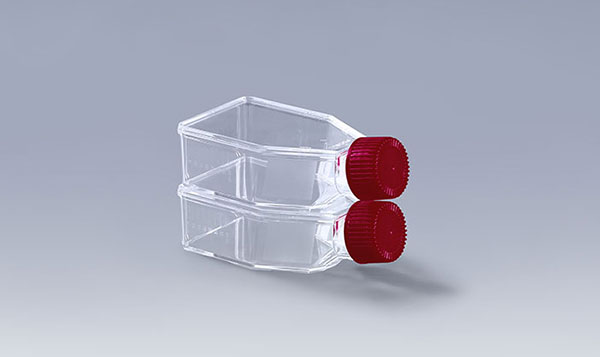
T25 TC-treated Cell Culture Flask
6. Check Caps and Vent Filters
The cap is another important part of incoming inspection.
For vented cell culture flasks, check whether:
The cap is correctly assembled
The vent membrane is intact
No visible contamination is present
The cap has not been crushed or displaced
For seal-cap configurations, inspect the cap and threads for physical damage.
If the cap appears loose or damaged inside an unopened sterile package, the affected unit should be documented and reviewed.
7. Review Quality Documents
Depending on the purchasing requirements, the shipment may also need to be matched with supporting documentation.
Common documents may include:
Product specification
Certificate of Analysis
Sterility information
Endotoxin information
DNase/RNase-free statement
Batch-related quality documents
Quality system certificates
The required document package will depend on the application.
Routine research laboratories may require fewer documents, while biopharma companies, distributors, vaccine-related users, and OEM customers may require a more complete package.
8. Record Any Nonconformity
When a problem is identified, record the details before contacting the supplier.
Useful information includes:
Product catalogue number
Lot number
Quantity affected
Carton number
Description of the defect
Photographs
Date received
Clear records make it easier for the supplier to investigate whether the issue is related to a single unit, one carton, one shipment, or an entire production lot.
Products with questionable sterile packaging, major deformation, missing identification, or other significant defects should remain separated until their disposition is decided.
9. Consider Sample Testing for a New Supplier
Visual inspection confirms product condition, but it does not fully evaluate biological performance.
When qualifying a new cell culture flask supplier, laboratories may also test representative samples for:
Cell attachment
Cell spreading
Morphology
Confluence uniformity
Viable cell yield
Harvest performance
This is especially useful when switching from an existing flask brand or approving a new supplier for routine or bulk purchasing.
Incoming inspection and cell culture evaluation therefore serve different purposes: one checks the received product, while the other confirms performance under actual culture conditions.
Building a Consistent Incoming Inspection Process
Incoming inspection for sterile cell culture flasks should focus on four main areas:
Packaging integrity → Product identification → Physical condition → Batch documentation
A simple, repeatable inspection process can help laboratories identify problems before products enter routine use and create clearer records for supplier management.
FDCELL supplies sterile cell culture flasks in T25, T75, T175, and T225 sizes, with TC-treated and non-treated surfaces and vented or seal cap options.
For bulk, distributor, and OEM orders, customers can confirm packaging, labeling, documentation, and batch traceability requirements before shipment to help simplify incoming inspection after delivery.










