MDCK cell culture is widely used in virology research, vaccine development, and cell-based production processes. As an adherent cell line, MDCK cells require a reliable growth surface, stable culture conditions, and a scalable vessel system when moving from laboratory development to larger production volumes. For manufacturers and research teams looking to increase adherent cell culture capacity without switching too early to complex bioreactor systems, multilayer cell factories provide a practical and efficient scale-up option.

Why MDCK Cells Are Commonly Cultured in Cell Factories
MDCK cells are often selected for virus propagation and vaccine-related applications because they can support the growth of several clinically and industrially relevant viruses. In many workflows, the process begins in cell culture flasks and gradually expands into larger surface-area systems. Multilayer cell factories are especially useful at this stage because they provide a larger culture area while maintaining a familiar adherent culture format.
Compared with using many individual flasks, a cell factory can reduce handling steps, save incubator space, and improve process consistency. This is important for MDCK cell expansion, where uniform attachment, stable morphology, and controlled medium distribution all influence the final cell yield and downstream virus production performance.
Key Requirements for MDCK Cell Culture Scale-Up
Successful MDCK cell culture in multilayer cell factories depends on more than simply increasing the culture area. The vessel design, surface treatment, medium volume, seeding density, and handling method all affect cell attachment and growth uniformity.
A TC-treated surface is commonly preferred for adherent MDCK cells because it improves cell attachment and supports stable monolayer formation. When scaling up from flasks to multilayer cell factories, the surface should provide consistent hydrophilicity across each layer. Uneven surface treatment may lead to differences in cell distribution, delayed attachment, or lower harvest consistency.
Seeding density is another key factor. If the initial cell density is too low, MDCK cells may require longer culture time to reach the desired confluence. If the density is too high, cells may become over-confluent before infection or harvest. For vaccine production and virus amplification workflows, users should optimize the seeding density according to the target confluence, infection timing, and medium formulation.
Medium Distribution and Handling in Multilayer Cell Factories
Medium distribution is one of the most important operational points when using multilayer cell factories for MDCK cell culture. During filling, the culture medium and cell suspension should be distributed evenly across all layers. Gentle and consistent handling helps avoid air bubbles, uneven liquid flow, and localized areas with poor cell attachment.
For MDCK cells, a uniform monolayer is especially important when the cell factory is used for virus production. Uneven cell growth may result in inconsistent infection efficiency and variable virus yield between layers. Operators should follow a validated filling, distribution, incubation, and harvesting procedure to ensure that each layer receives a similar cell suspension volume.
Closed or semi-closed handling can also help reduce contamination risk during large-scale adherent cell culture. In production-oriented environments, cell factories with tubing assemblies or compatible transfer systems may support safer liquid handling, especially during medium exchange, washing, infection, and harvest steps.
From Cell Culture Flask to Multilayer Cell Factory
Many MDCK cell culture workflows start with T-flasks, such as T75, T175, or T225 cell culture flasks. Once the process is stable, users often scale up to multilayer cell factories to increase total growth area without greatly changing the adherent culture format.
Before changing vessel formats, it is recommended to compare key culture parameters, including attachment rate, cell morphology, confluence time, viability, and final cell yield. For vaccine-related applications, additional process indicators such as infection efficiency and virus harvest consistency should also be evaluated.
A stepwise scale-up strategy may include:
Starting with small cell culture flasks to confirm MDCK cell recovery and growth performance.
Moving to larger flasks to optimize seeding density and medium volume.
Transferring the process to 10-layer or 40-layer multilayer cell factories for higher surface area.
Validating cell growth uniformity, medium exchange, and harvest performance before routine use.
This gradual approach helps reduce process risk and makes it easier to identify whether changes in performance are related to the vessel, surface treatment, operation method, or culture medium.
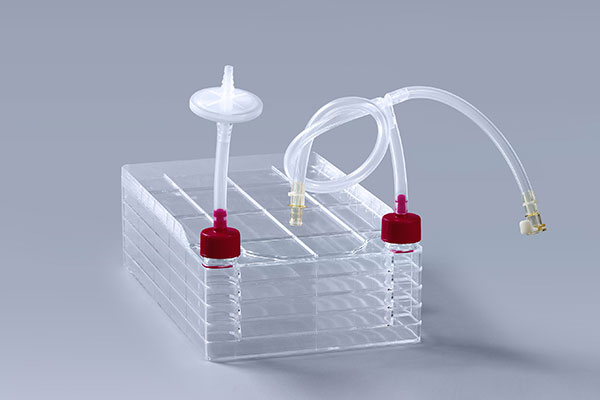
Closed System Cell Factory with Tube
Application in Vaccine Production Workflows
MDCK cells are closely associated with vaccine research and production, particularly in cell-based virus propagation. In these workflows, multilayer cell factories can support the expansion of adherent MDCK cells before virus infection. The large surface area allows users to prepare more cells per unit of incubator space, which can be useful for pilot-scale production, process development, and manufacturing transition stages.
For vaccine companies, consistency is often more important than simply increasing scale. A reliable cell factory should support uniform cell growth, stable monolayer formation, and reproducible harvest results. This is why surface quality, product sterility, material safety, and batch traceability should be considered when selecting a multilayer cell factory supplier.
Choosing the Right Cell Factory for MDCK Cell Culture
When selecting a cell factory for MDCK cell culture, users should focus on several practical factors. The first is the culture surface. A consistent TC-treated surface helps support MDCK cell attachment and spreading. The second is the layer design. Good flatness and stable structure help maintain even liquid distribution and reduce culture variation between layers.
The third factor is ease of operation. Cell factories used in vaccine or biopharma workflows should allow convenient filling, medium exchange, and harvesting. For larger-scale processes, compatibility with tubing systems can improve handling efficiency and reduce repeated manual operations.
Finally, documentation and quality control are important for regulated or production-related environments. Sterility assurance, endotoxin control, DNase/RNase-free status, and lot traceability all help users build a more reliable MDCK cell culture process.
FDCELL Multilayer Cell Factories for MDCK Cell Culture
FDCELL provides multilayer cell factories designed for adherent cell culture scale-up, including applications involving MDCK cells, Vero cells, HEK293 cells, and other commonly used cell lines. With a TC-treated growth surface, stable structure, and multiple layer options, FDCELL cell factories help laboratories and biopharma companies improve culture area, reduce handling workload, and support more consistent scale-up from cell culture flasks.
For customers working on MDCK cell expansion, vaccine development, or adherent cell culture production, FDCELL can provide cell factories, cell culture flasks, media bottles, and related cell culture consumables to support upstream process workflows.
Conclusion
MDCK cell culture in multilayer cell factories provides a practical route for scaling adherent cell expansion while maintaining a familiar culture format. By selecting a suitable TC-treated cell factory, optimizing seeding density, controlling medium distribution, and validating culture consistency, users can improve MDCK cell growth performance and support more reliable vaccine production or process development workflows.
For biopharma companies, vaccine manufacturers, research laboratories, and distributors looking for reliable cell culture consumables, FDCELL offers multilayer cell factories and related products for scalable, consistent, and efficient adherent cell culture.










