Selecting a Media Bottle is not simply a matter of choosing the right volume or bottle shape. The type of liquid being stored is equally important. Culture media, buffers, sera, aqueous reagents, and solvent-containing solutions can interact differently with PET and PETG materials, and their storage requirements may vary significantly.
For life science and biopharmaceutical laboratories, understanding solution compatibility helps protect liquid integrity while reducing the risk of container deformation, leakage, or unexpected material interactions.
This guide looks at common solution types stored in Media Bottles and the factors laboratories should evaluate before selecting a container.
1. Cell Culture Media
Cell culture media are among the most common liquids stored in laboratory Media Bottles. Depending on the formulation, they may contain salts, amino acids, glucose, vitamins, proteins, and other supplements.
For these applications, bottle selection should consider:
Compatibility with aqueous media formulations
Low risk of unwanted material interaction
Reliable closure performance
High transparency for visual inspection
Sterile availability when required
PETG Media Bottles are commonly used for prepared cell culture media because PETG combines optical clarity, toughness, and suitability for sterile laboratory workflows.
However, the storage conditions specified for the particular medium should always take priority over the general capabilities of the bottle.
2. Sera and Protein-Containing Solutions
Sera and protein-containing supplements require careful handling because their biological components can be sensitive to contamination and storage conditions.
A suitable Media Bottle should provide a secure closure and sufficient mechanical strength for the intended handling and storage environment. High transparency is also useful for visually checking the contents for precipitation, turbidity, or other unexpected changes.
For laboratories that divide larger volumes into smaller working quantities, multiple bottle sizes can also help reduce repeated opening of the primary container.
3. Buffer Solutions
Buffers such as phosphate-based and other aqueous laboratory buffers are routinely prepared and stored during research and bioprocess development.
Although many common aqueous buffers are compatible with PET and PETG, compatibility should not be assumed solely because a solution is water-based. Important factors include:
Buffer composition
pH
Concentration
Storage temperature
Contact time
When a buffer will remain in a Media Bottle for an extended period, laboratories should evaluate compatibility under the actual conditions of use rather than relying only on general material descriptions.
4. pH-Sensitive Solutions
Some media and reagents are particularly sensitive to changes in pH. In these applications, the bottle and closure system should be considered together.
Gas exchange, evaporation, repeated opening, and storage conditions may all influence solution stability. A well-sealed PETG Media Bottle can help limit unintended environmental exposure, but container selection alone cannot guarantee pH stability.
The complete storage system—including closure integrity, temperature, headspace, light exposure, and the formulation itself—should therefore be evaluated.
5. Saline and Other Aqueous Solutions
Saline solutions and many routine aqueous reagents generally represent relatively straightforward storage applications for PET and PETG Media Bottles.
For these solutions, laboratories may focus more heavily on practical characteristics such as:
Leak resistance
Bottle size
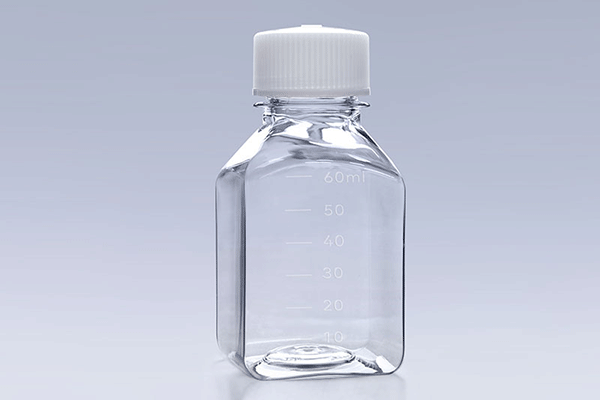
Graduation visibility
Handling convenience
Storage efficiency
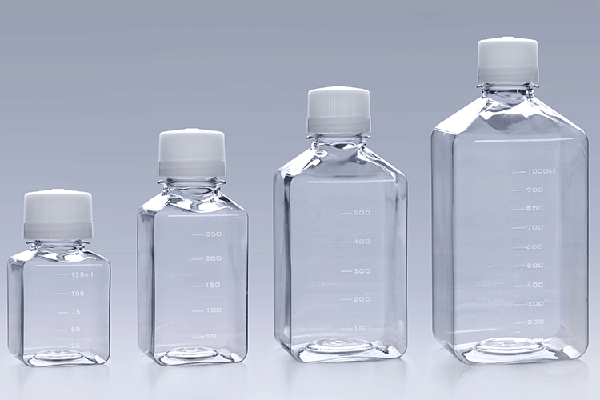
Square Media Bottles can be particularly useful when multiple bottles need to be organized in refrigerators, cabinets, or laboratory storage areas.
6. Alcohol-Containing and Solvent-Based Solutions
Greater caution is required when storing solutions containing alcohols, organic solvents, or other aggressive chemicals.
PET and PETG do not have universal compatibility with every chemical. Solvent type, concentration, temperature, and exposure duration can all affect bottle performance.
Potential concerns include:
Swelling or deformation
Stress cracking
Changes in mechanical strength
Increased chemical migration
Reduced closure performance
Before using a Media Bottle for a solvent-containing formulation, laboratories should review the manufacturer's chemical compatibility information and conduct application-specific testing where necessary.
For highly aggressive solvents, another container material may be more appropriate.
7. Cold-Stored and Frozen Solutions
Compatibility also depends on storage temperature.
A material that performs well at room temperature may behave differently under refrigerated or frozen conditions. When selecting bottles for cold storage, laboratories should consider not only the bottle body but also closure performance and the physical behavior of the stored liquid.
For example, freezing can cause liquids to expand. Adequate headspace should therefore be maintained rather than filling a bottle to its maximum capacity.
PETG is valued for its toughness at low temperatures, making PETG Media Bottles useful for many cold-storage applications. However, suitability should always be confirmed for the specific temperature, solution, fill volume, and freeze-thaw conditions involved.
8. How to Evaluate Media Bottle Compatibility
There is no single Media Bottle that is automatically suitable for every laboratory solution. A more reliable selection process considers the complete application.
Before choosing a bottle, ask:
What is the chemical composition of the solution?
What is its pH and concentration?
How long will it be stored?
At what temperature?
Will the solution be frozen?
Is sterility required?
Is the formulation sensitive to light, oxygen, CO₂, or evaporation?
Will the bottle be transported after filling?
For critical or unfamiliar formulations, compatibility testing under actual use conditions is recommended.
PET or PETG: Which Media Bottle Should You Choose?
Both PET and PETG can be suitable for laboratory liquid storage, but the final choice should be application-driven.
PET Media Bottles provide high clarity and rigidity and can be suitable for many routine aqueous storage applications. PETG Media Bottles offer greater toughness and are frequently selected for sterile and low-temperature laboratory workflows.
Bottle geometry should also be considered. Square Media Bottles provide efficient use of storage space and stable positioning, which can be advantageous when laboratories manage multiple solutions, concentrations, or batches simultaneously.
Conclusion
Media bottle compatibility depends on much more than the name of the bottle material. The chemical composition of the stored solution, concentration, temperature, contact time, sterilization requirements, and storage conditions all influence whether a particular Media Bottle is appropriate.
PET and PETG Media Bottles can support a broad range of culture media, buffers, sera, and aqueous laboratory solutions, while solvent-containing or otherwise aggressive formulations require more careful evaluation.
For laboratories managing multiple liquid types, selecting the appropriate material and bottle configuration—including space-efficient Square Media Bottles—helps create a safer and more reliable storage workflow.
For application-specific requirements, FDCELL can provide technical information to help customers evaluate the appropriate media bottle material, size, and configuration for their intended storage conditions.










