How often should you change the medium in a cell culture flask?There is no single schedule that fits every cell line. Medium exchange timing depends on cell density, growth rate, medium formulation, working volume, and the condition of the culture.
Changing medium too late may lead to nutrient depletion and waste accumulation, while changing it too frequently can disturb cells and increase unnecessary handling.

cell culture flask
1. Watch Cell Density
As cells become more confluent, nutrient consumption usually increases and the culture environment changes faster.
A low-density culture may not need the same feeding frequency as a flask approaching high confluence. Medium exchange timing should therefore be adjusted according to actual cell growth rather than a fixed schedule alone.
2. Check Medium Condition
Changes in medium colour can provide a useful visual indication of changing culture conditions.
For media containing phenol red, a shift toward yellow may suggest increasing acidity. However, colour should not be used as the only indicator because it can also be affected by CO₂, temperature, and time outside the incubator.
Medium condition should be considered together with:
Cell morphology
Confluence
Growth rate
Established culture protocol
3. Consider Cell Type and Growth Rate
Different cell types consume nutrients at different rates.
Fast-growing cells may require more frequent medium exchange than slow-growing cells. Primary cells, stem cells, and sensitive cell lines may also require different feeding strategies.
The recommended protocol for the specific cell type should be used as the starting point.
4. Working Volume Matters
Medium volume also affects exchange timing.
If too little medium is used, nutrients may be depleted faster and pH may change more quickly. When scaling from T25 or T75 flasks to T175 or T225 flasks, the medium volume should be adjusted according to the larger growth area.
Users should avoid simply increasing or reducing medium volume without considering the requirements of the cell line.
5. Avoid Changing Medium Too Early
After seeding, adherent cells need time to settle and attach to the TC-treated surface.
Changing medium too soon may remove cells that have not yet attached firmly, especially during:
Post-thaw recovery
Low-density seeding
Early passage culture
Sensitive cell culture
The first medium exchange should therefore follow the established protocol and the actual attachment condition of the cells.
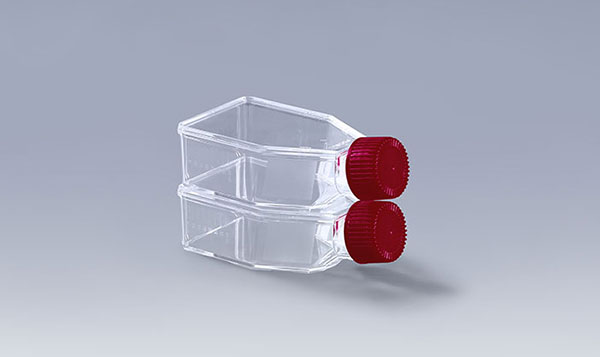
T25 TC-treated Cell Culture Flask
6. Medium Exchange Technique Also Matters
Correct timing alone is not enough. Poor handling can disturb the cell layer.
During medium exchange:
Avoid directing liquid directly onto the cells
Do not allow the growth surface to dry
Add fresh medium gently
Minimize the time outside the incubator
Avoid introducing excessive air bubbles
Gentle and consistent handling helps maintain more uniform cell growth.
When Should You Change the Medium?
A medium exchange may be appropriate when:
Cell density has increased significantly
Medium colour has changed noticeably
The scheduled feeding interval has been reached
Cell growth begins to slow
The protocol requires fresh medium
The culture is approaching the next passage stage
No single indicator should be used alone.
Building a Consistent Feeding Schedule
For reproducible cell culture, laboratories should define and record:
Flask size
Seeding density
Working volume
Medium formulation
Feeding interval
Target confluence
FDCELL supplies sterile cell culture flasks in T25, T75, T175, and T225 sizes, with TC-treated and non-treated surfaces and different cap options available.
A consistent medium exchange strategy, combined with stable culture conditions and suitable cell culture flasks, can help improve culture reproducibility and cell growth consistency.










