I. Introduction
Mesenchymal stem cells (MSCs) are widely recognized for their immunomodulatory, anti-inflammatory, and regenerative properties, and have become one of the most promising candidates in cell-based therapies.
However, as MSC therapies progress from laboratory research to clinical and commercial production, the challenge of large-scale expansion has become increasingly apparent.
II. The Unique Nature of MSCs
Unlike immortalized or tumor-derived cell lines, MSCs are primary cells with limited division potential.
Their proliferation rate and phenotype are highly sensitive to:
Microenvironmental changes (temperature, CO₂, pH);
Nutrient depletion and waste accumulation;
Mechanical stress during medium exchange.
Unlike other industrial cell lines, MSCs require an adherent culture surface, meaning that scalable expansion must balance surface area, oxygen exchange, and uniformity.
III. From Flask to Cell Factory: Scaling the MSC Process
Traditional cell culture flasks are suitable for small-scale research, but insufficient for producing billions of viable MSCs required in clinical manufacturing.
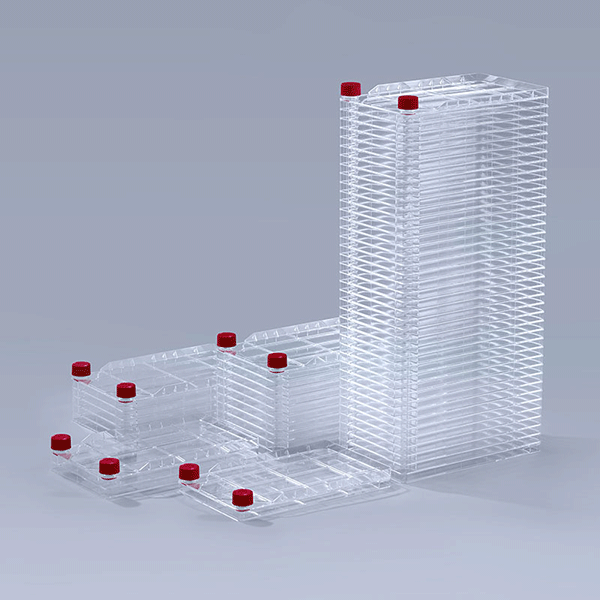
To achieve large-scale yet consistent output, manufacturers are turning to multi-layer cell factory systems and automated closed platforms.
Advantages of Multi-Layer Cell Factory:
Significantly increased surface area in a compact footprint;
Uniform gas and nutrient distribution across all layers;
Compatibility with automated filling and harvesting systems;
Closed-loop design reducing contamination risk.
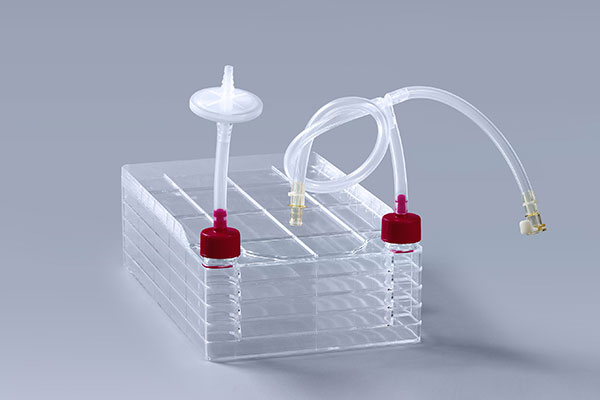
Cell factory with Tubing Systems
IV. Process Control and Quality Consistency
MSC quality is highly sensitive to shear stress, oxygen gradient, and passage number.
Thus, controlling each environmental parameter during large-scale expansion is essential to ensure:
Morphological uniformity;
Retention of differentiation potential;
Stable immunomodulatory function.
Advanced closed cell factory systems, with precise gas control and gentle flow paths, provide stable and repeatable environments for MSC expansion — a crucial step toward GMP-level production.
V. Future Trends: Toward Automated and Scalable Platforms
As MSC therapy enters the commercial stage, manufacturers are prioritizing:
Automation and monitoring integration (real-time pH, DO, and temperature feedback);
Serum-free and xeno-free media to ensure clinical safety;
Modular scalability, allowing seamless transition from R&D to manufacturing.

Guide to Choosing a Cell Culture Flask
VI. Conclusion
MSC therapy represents a milestone in regenerative medicine, but scaling up MSC culture remains a critical technical bottleneck.
Through the use of high-quality cell factory, precise process control, and closed-system design, the industry is moving closer to achieving truly consistent and efficient MSC manufacturing.










