For biopharmaceutical laboratories, selecting a PETG media bottle involves more than checking bottle size, sterility, or closure design. When containers are used to store culture media, buffers, process solutions, or other sensitive liquids, buyers may also need information about potential material-related chemical risks.
This is where Extractables and Leachables (E&L) documentation becomes relevant.For procurement teams, quality departments, and laboratory users, the key question is not simply whether a supplier can provide an “E&L report,” but whether the available documentation is relevant to the specific media bottle, material, manufacturing process, and intended application.
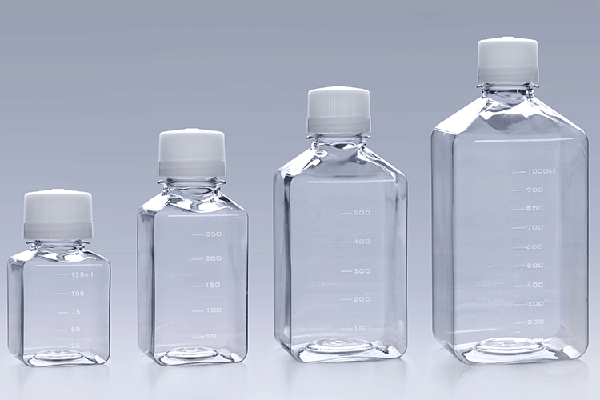
Why E&L Documentation Matters for PETG Media Bottles
A PETG bottle, cap, and other product-contact components are made from polymeric materials that may contain additives, processing-related substances, or other chemical constituents.
Under certain conditions, chemical species may migrate from these materials into a contacting liquid. The extent of migration can be influenced by factors such as:
Contact time
Temperature
Solution composition
pH
Sterilization method
Surface-area-to-volume ratio
Storage conditions
For this reason, E&L information can become an important part of material assessment when a PETG media bottle is introduced into biopharmaceutical or other controlled laboratory workflows.
Extractables vs. Leachables: What Is the Difference?
Although the two terms are often discussed together, they represent different concepts.
Extractables are chemical compounds that can be released from a material under defined laboratory extraction conditions, often using conditions designed to characterize potential chemical migrants.
Leachables are compounds that actually migrate into the stored solution under normal or defined conditions of use.
For a media bottle supplier, extractables data can provide useful information about the chemical profile of product-contact materials. However, leachables assessment is more closely related to the customer's actual formulation, storage conditions, and duration of contact.
This distinction is important when reviewing supplier documentation.
What E&L Documentation Should Buyers Review?
When evaluating a PETG media bottle, buyers should look beyond a single test result. A useful documentation package should help identify exactly what was tested and under what conditions.
1. Material Identification
The documentation should clearly identify the product-contact materials used in the bottle system.
For PETG media bottles, this may include:
PETG bottle body
Closure material
Any additional product-contact components
Material identification helps customers determine whether the available test data are relevant to the actual bottle configuration being purchased.
2. Tested Product Configuration
Buyers should confirm whether the E&L information applies to the same product or material used in the supplied media bottle.
Changes in resin formulation, closure material, manufacturing process, or sterilization conditions may affect the relevance of existing data.
This is particularly important when qualifying a new supplier or replacing an existing bottle in a controlled process.
3. Extraction Conditions
An extractables report should describe the conditions used during testing, including factors such as:
Extraction solvent
Temperature
Contact duration
Sample preparation
Surface-area-to-volume ratio
Without this information, it can be difficult for users to determine how the results relate to their actual application.
4. Analytical Methods
E&L studies may use different analytical techniques to detect different classes of compounds.
Depending on the study design, analytical methods may include chromatographic and spectrometric techniques for evaluating volatile, semi-volatile, non-volatile, and elemental species.
For buyers, the objective is not necessarily to demand every possible analytical method, but to understand the scope of the supplier's testing and whether it provides meaningful chemical characterization.
Does Gamma Sterilization Matter?
For sterile PETG media bottles, sterilization should be considered when reviewing E&L information.
Gamma irradiation can affect polymer materials, meaning E&L data generated from a non-sterilized material may not always fully represent a gamma-sterilized finished product.
When the purchased bottle is supplied sterile, buyers should therefore determine whether the available chemical characterization data appropriately reflect the sterilized product or whether additional assessment is necessary.
This is especially relevant for applications involving long contact periods or sensitive biological solutions.
E&L Documentation Is Not the Same as Application Compatibility
An important point for buyers is that an E&L report does not automatically prove that a PETG media bottle is compatible with every culture medium, buffer, reagent, or process solution.
Actual leachables behavior depends heavily on the liquid being stored and the conditions of use.
For example, differences in:
pH
Organic content
Storage temperature
Contact duration
Freeze-thaw conditions
may influence material interaction.
Therefore, supplier E&L documentation should be viewed as part of a broader risk assessment rather than a universal compatibility certificate.
E&L Information During Supplier Qualification
When qualifying a new media bottle manufacturer, quality and procurement teams may evaluate several types of supporting information together.
These can include:
Material specifications
E&L or chemical characterization information
Biocompatibility information where applicable
Sterilization documentation
Lot traceability
Quality certificates
Change-control procedures
Product specifications
The objective is to establish sufficient understanding of the product and its manufacturing controls before introducing it into the intended workflow.
For customers switching from an existing PETG media bottle supplier, having organized technical documentation can also make internal evaluation more efficient.
Why Change Control Is Important
E&L assessment should not be considered completely separate from supplier change control.
Changes involving raw materials, resin suppliers, formulations, manufacturing processes, closures, or sterilization conditions could potentially affect the chemical profile of a media bottle.
For regulated or validated applications, buyers should therefore consider whether the manufacturer has procedures for managing and communicating significant product changes.
Consistent material control helps ensure that documentation generated during initial qualification remains relevant over time.
What Should You Ask a PETG Media Bottle Supplier?
Before approving a supplier, buyers can ask several practical questions:
What are the product-contact materials?
Is chemical characterization or extractables information available?
Which bottle configuration was evaluated?
Were sterilized products included in the assessment?
What extraction conditions were used?
Can material and sterilization documentation be provided?
How are raw-material or manufacturing changes controlled?
Is batch traceability available?
These questions provide more useful information than simply asking, “Do you have an E&L report?”
Conclusion
For biopharmaceutical customers, PETG media bottle Extractables and Leachables documentation is an important part of understanding material-related risk, particularly when bottles are used with sensitive solutions or introduced into controlled processes.
A useful documentation package should clearly connect the test data with the bottle material, product configuration, sterilization status, and test conditions. At the same time, buyers should recognize that supplier extractables data cannot replace application-specific leachables or compatibility assessment when such evaluation is required.
When sourcing PETG media bottles, reviewing E&L information together with material specifications, sterilization records, traceability, and change-control practices provides a more complete basis for supplier qualification and long-term product evaluation.










