Trypsinization is a routine step in adherent cell culture, but poor control of the detachment process can lead to incomplete cell recovery, excessive cell damage, clumping, and inconsistent yields.
Whether cells are grown in a T25, T75, T175, or T225 cell culture flask, successful harvesting depends not only on the trypsin concentration but also on cell confluence, washing, exposure time, temperature, and handling technique.
For laboratories using tissue culture flasks for routine expansion, a consistent trypsinization procedure can help improve viable cell recovery and make passage-to-passage results more reproducible.

cell culture flask
1. Avoid Excessive Confluence Before Harvest
The condition of the culture before trypsinization strongly affects cell recovery.
When adherent cells become over-confluent, they may form stronger cell-to-cell contacts and become more difficult to detach evenly. Prolonged over-confluence can also affect morphology, growth rate, and subsequent recovery after reseeding.
A more consistent approach is to harvest cells within the appropriate confluence range established for the specific cell line.
Before detachment, check:
Cell morphology
Confluence
Evidence of cell clustering
Medium condition
Contamination status
Do not determine harvest timing only by the number of days in culture.
2. Remove Residual Medium Before Adding Trypsin
Serum-containing culture medium can reduce trypsin activity.
After removing the culture medium, the cell layer is commonly washed with an appropriate balanced salt solution according to the established cell culture protocol. This helps remove residual serum and allows the dissociation reagent to contact the cells more effectively.
When washing a tissue culture flask, add and remove the solution gently to avoid dislodging cells before the actual detachment step.
3. Use Enough Trypsin to Cover the Growth Surface
The dissociation reagent should contact the entire cell growth area.
Using too little solution may leave parts of a larger T-flask insufficiently exposed, causing cells in some regions to detach while others remain attached.
This becomes increasingly important when moving from smaller T25 or T75 flasks to larger T175 and T225 formats.
The goal is not to fill the flask with trypsin, but to ensure uniform contact with the growth surface according to the validated procedure for the cell type.
4. Do Not Over-Trypsinize
Longer exposure does not necessarily mean better cell recovery.
Excessive trypsinization can damage cell-surface proteins and may negatively affect viability, attachment, and recovery after passage.
Instead of relying only on a fixed time, observe the cells during detachment. Typical signs of progressing detachment may include:
Cells becoming more rounded
Reduced attachment to the surface
Separation between neighbouring cells
Cells beginning to release with gentle flask movement
Once sufficient detachment has occurred, trypsin activity should be stopped or neutralized according to the specific protocol.
Different cell lines can respond very differently, so the appropriate exposure time should be established experimentally.
5. Use Gentle Mechanical Assistance
When cells have rounded but remain loosely attached, gentle tapping or controlled movement of the T-flask may help release them.
Avoid aggressive shaking or repeated forceful impact. Excessive mechanical stress can damage cells and may create unnecessary variability between operators.
Similarly, when collecting the detached cells, pipetting should be sufficient to create a reasonably uniform suspension without excessive foaming.
The aim is to recover cells efficiently while preserving viability.
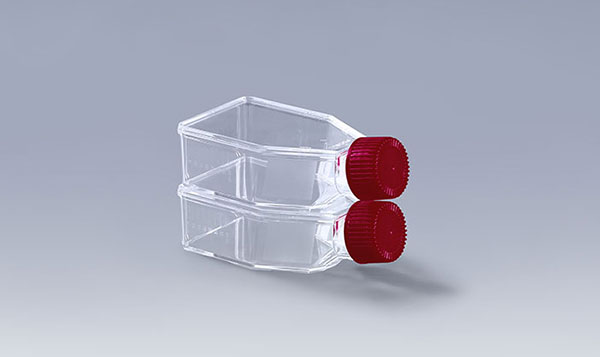
T25 TC-treated Cell Culture Flask
6. Check for Cells Remaining on the Flask
After collecting the cell suspension, inspect the cell culture flask under a microscope if possible.
Large numbers of cells remaining on the surface may indicate:
Insufficient washing
Incomplete trypsin coverage
Too short an exposure time
Excessive confluence
Uneven surface contact
Cell-line-specific resistance to detachment
Repeatedly increasing trypsin exposure without identifying the underlying cause may reduce cell quality.
Comparing residual cells on the growth surface with the viable cell count after harvesting provides a more useful picture of recovery efficiency.
7. Consider Flask Size During Scale-Up
A trypsinization procedure that works well in a T25 flask may require adjustment when moving to a T175 or T225 tissue culture flask.
Larger growth areas can increase:
Total cell number
Required washing volume
Dissociation reagent volume
Time required to distribute and remove liquids
Cell collection workload
When scaling up, laboratories should keep the procedure as consistent as possible while confirming that the entire growth surface receives comparable treatment.
If many large T-flasks are required for one batch, handling time itself can become an important process variable.
8. Evaluate Recovery After Reseeding
Successful trypsinization should not be judged only by how many cells detach.
The recovered cells should also be evaluated after reseeding. Important indicators include:
Viable cell count
Attachment efficiency
Cell morphology
Spreading after attachment
Growth rate
Time to expected confluence
If the harvested cell number is high but attachment after passage is poor, excessive enzymatic or mechanical treatment may be one possible factor to investigate.
Building a Consistent T-Flask Harvesting Procedure
For reproducible harvesting from cell culture flasks, laboratories should standardize key variables such as:
Target confluence
Washing procedure
Trypsin volume
Exposure time
Detachment endpoint
Mechanical handling
Neutralization method
Viable cell counting
FDCELL supplies sterile cell culture flasks and tissue culture flasks in T25, T75, T175, and T225 sizes, with TC-treated surfaces available for adherent cell culture.
When evaluating a new flask or changing flask size, laboratories should compare cell attachment, detachment efficiency, viable cell recovery, and post-passage growth under consistent culture conditions.










