In modern biopharmaceutical production and life science research, scaling up adherent cell cultures efficiently and consistently remains a critical challenge. While traditional vessels such as T flasks are widely used for early-stage culture, they quickly become impractical as demand increases. This is where Cell Factory play a pivotal role.
This article explores when and why Cell Factory should be used for large-scale cell expansion, and how they compare to other culture systems.
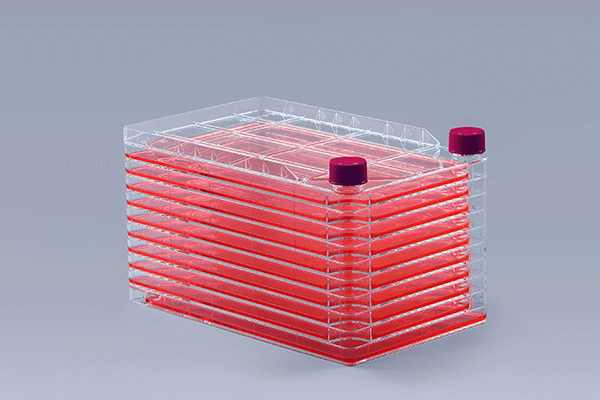
Cell Factory 10 Layers TC-treated
What Are Cell Factory?
Cell Factory are multi-layered cell culture systems designed to provide a large surface area for adherent cell growth within a compact footprint. Typically made from high-quality polystyrene with treated surfaces for optimal cell attachment, they are widely used in:
Vaccine production
Biopharmaceutical manufacturing
Cell therapy research
Large-scale protein expression
Compared to standard tissue culture flasks, Cell Factory significantly increase culture capacity without proportionally increasing space or labor requirements.
When Should You Use Cell Factory?
1. When Scaling Beyond T Flask Becomes Inefficient
Tissue culture flasks (T25, T75, T175,T225) are ideal for small-scale experiments and early-stage cell expansion. However, when your process requires dozens or even hundreds of flasks, challenges arise:
Increased handling time
Higher contamination risk
Inconsistent culture conditions
At this point, switching to Cell Factory helps streamline operations by consolidating multiple flasks into a single system.
2. When You Need High Surface Area in Limited Space
Cell Factory offer multiple stacked layers (e.g., 2-layer, 10-layer, 40-layer systems), dramatically increasing the available growth surface area.
Benefits include:
Maximized incubator space utilization
Reduced equipment footprint
Easier scalability
This makes them particularly valuable in facilities with limited cleanroom or incubator capacity.
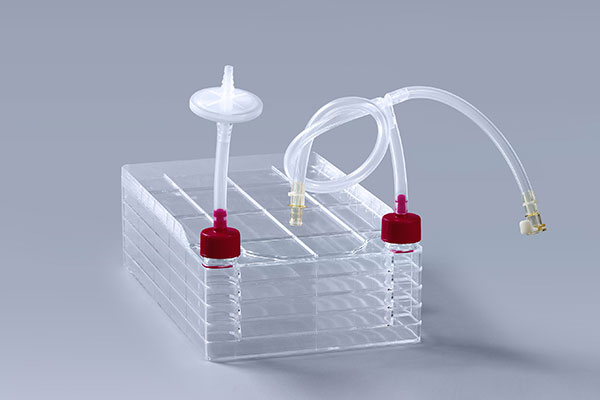
Closed System Cell Factory with Tube
3. When Producing Adherent Cells at Scale
Certain cell lines, such as Vero, HEK293, and primary cells, require surface attachment for growth. For these adherent cells, Cell Factory provide:
Uniform growth environments
Reliable cell attachment (via TC-treated surfaces)
Scalable production without transitioning to suspension culture
This is especially important in vaccine manufacturing and viral vector production.
4. When Process Consistency and Reproducibility Matter
In large-scale production, batch-to-batch consistency is critical. Cell Factory help standardize:
Seeding density
Media distribution
Gas exchange conditions
By reducing variability introduced by handling multiple smaller vessels, they improve reproducibility across batches.
5. When Reducing Labor and Contamination Risk Is a Priority
Handling hundreds of flasks increases the risk of contamination and operator error. Cell Factory minimize these risks by:
Reducing the number of handling steps
Supporting closed or semi-closed systems
Simplifying media exchange and cell harvesting
This leads to improved operational efficiency and safer production workflows.
Cell Factory vs. Other Scale-Up Options
| System | Best Use Case | Limitations |
| T Flask | Small-scale research | Labor-intensive at scale |
| Cell Factories | Mid-to-large scale adherent culture | Manual handling still required |
| Roller Bottles | Moderate scale, improved gas exchange | Requires rolling equipment |
| Bioreactors (Microcarriers) | Very large-scale production | Higher complexity and cost |
Cell Factory often serve as a bridge between T flasks and fully automated bioreactor systems, making them an ideal intermediate scale-up solution.
Key Considerations Before Using Cell Factory
Before transitioning to Cell Factory, consider the following:
Cell type compatibility: Ensure your cells grow well in multi-layer systems
Media consumption: Larger volumes require optimized media usage
Handling capability: Staff should be trained in handling larger vessels
Facility setup: Incubators must accommodate the size of Cell Factory

Conclusion
Cell Factory are an essential tool for large-scale expansion of adherent cells, offering a balance between scalability, cost-effectiveness, and operational simplicity. They are particularly valuable when transitioning from laboratory-scale research to pilot or production-scale processes.
By adopting Cell Factory at the right stage, laboratories and manufacturers can significantly improve efficiency, reduce risk, and ensure consistent, high-quality cell production.
If you are looking for reliable, high-quality cell factory systems for your applications, choosing a trusted manufacturer with strict quality control and consistent production standards is key to long-term success.










