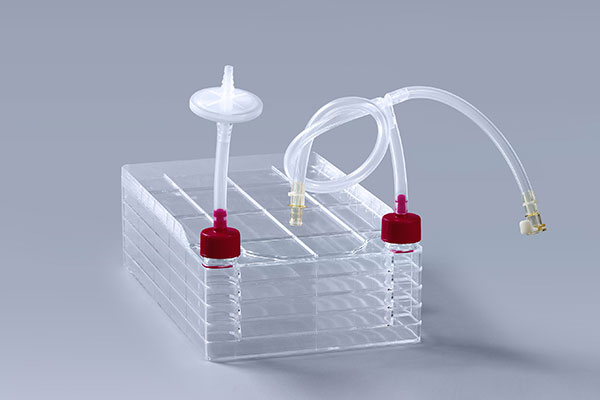
A Closed System Cell Factory combines a multilayer culture vessel with sterile tubing assemblies, connectors, filters and fluid containers to support media transfer, cell inoculation, medium exchange and harvesting.
As more components are integrated into the fluid pathway, maintaining system integrity becomes increasingly important. A small leak at the vessel, tubing or connection point may compromise closed-system operation and create additional risks during cell culture.
This is why leak testing is an important part of quality control for Closed System Cell Factory applications.
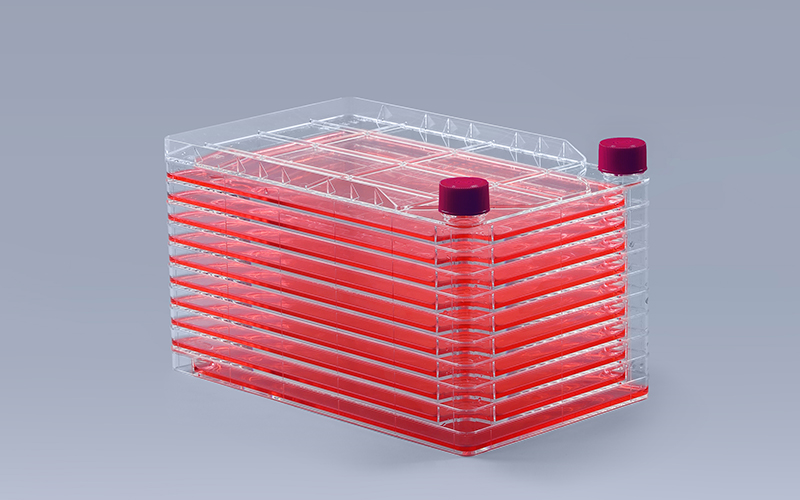
Cell Factory 10 Layers TC-treated
Why Is System Integrity Important?
Closed-system workflows are designed to reduce unnecessary exposure of the culture process to the surrounding environment.
For a Cell Factory connected to tubing assemblies, system integrity depends on multiple components working together, including:
Cell Factory vessel and ports
Tubing
Connectors and adapters
Filters
Seals and closures
Tubing-to-vessel connections
If any part of the system is damaged or improperly connected, the intended closed fluid pathway may be affected.
Leak testing helps identify potential integrity problems before the system is used in a critical cell culture process.
Where Can Leakage Occur?
A closed Cell Factory system contains several potential connection points.
Areas requiring particular attention may include tubing connections, ports, connectors, caps, welded or bonded sections and other interfaces within the assembly.
Damage can also occur during manufacturing, packaging, transportation or handling.
For this reason, integrity should not be evaluated only by visually inspecting the Cell Factory vessel. The complete fluid pathway and its critical connections should also be considered.
Supporting Aseptic Fluid Transfer
A major reason for using a Closed System Cell Factory is to support more controlled fluid handling.
Media filling, inoculation, medium exchange and harvesting can be performed through connected tubing rather than repeatedly opening the culture vessel.
However, this advantage depends on maintaining the integrity of the system.
Leak testing provides an additional quality-control measure to verify that the system can maintain its intended closed configuration during fluid-transfer operations.
It is important to note that leak testing alone does not demonstrate sterility. Instead, it forms part of a broader quality system that may also include validated sterilization, environmental control, packaging integrity and manufacturing controls.
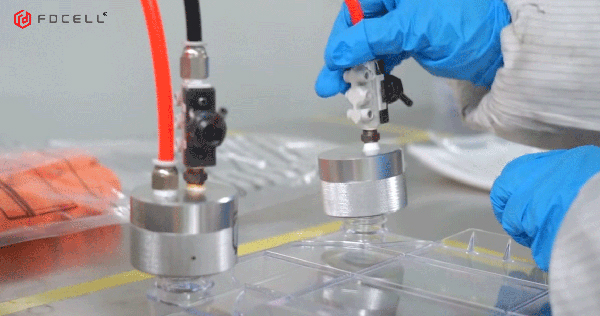
Cell Factory Sealing Test
Why Leak Testing Becomes More Important During Scale-Up
As adherent cell culture scales from smaller vessels to 10-layer or 40-layer Cell Factory systems, the volume of culture material and the value of each batch may increase significantly.
At the same time, larger workflows may involve more tubing, bags and connection points.
A leak discovered after inoculation or during medium exchange can disrupt the process and potentially result in loss of culture material.
Identifying integrity issues before use therefore becomes increasingly valuable as the process scales.
Leak Testing and Tubing Assembly Quality
For customized Cell Factory tubing assemblies, integrity depends not only on the individual components but also on how they are assembled.
A reliable quality-control process should pay attention to:
Tubing and connector compatibility
Secure connections
Sealing or bonding quality
Assembly consistency
Visible damage or deformation
Finished-system integrity
When evaluating a Cell Factory tubing assembly supplier, buyers should therefore consider both component specifications and the quality controls applied to the completed assembly.
FDCELL Closed System Cell Factory
FDCELL provides Closed System Cell Factory solutions with customizable sterile tubing assemblies for 1-layer, 2-layer, 5-layer, 10-layer and 40-layer configurations.
Different tubing materials, connectors and fluid-transfer configurations can be selected according to the customer's process requirements.
Quality control throughout manufacturing and assembly helps support reliable closed-system workflows for applications such as vaccine manufacturing, viral vector production and other large-scale adherent cell culture processes.
Conclusion
Leak testing is an important consideration for any Closed System Cell Factory because the performance of the system depends on the integrity of the entire fluid pathway.
From the Cell Factory vessel to tubing, connectors and connection points, each component contributes to maintaining a reliable closed configuration.
Combined with appropriate manufacturing, sterilization and quality controls, integrity testing can help reduce the risk of fluid leakage and support more consistent closed-system Cell Factory operations.










