Cell banking is an important part of maintaining consistent cell sources for research, biopharmaceutical development, vaccine production, and other cell-based applications.
Before cells are cryopreserved as a master cell bank, working cell bank, or research cell stock, they usually need to be recovered, expanded, monitored, and harvested under controlled conditions. During this preparation stage, cell culture flasks provide a practical platform for adherent cell expansion.
The goal is not simply to produce more cells. Cell condition, passage history, growth consistency, viability, and traceability should also be controlled before freezing.

cell culture flask
Why Cell Culture Before Banking Matters
The quality of a cell bank depends partly on the condition of the cells at the time of cryopreservation.
Before banking, laboratories typically evaluate factors such as:
Cell viability
Morphology
Growth rate
Passage number
Confluence
Contamination status
Cell identity and other required quality attributes
Poorly growing or stressed cells should not automatically be expanded simply to reach the required quantity.
A consistent pre-banking culture process helps create a more uniform starting population for subsequent cryopreservation and recovery.
Choosing the Right Flask Size
The appropriate cell culture flask depends on the number of cells available and the total cell quantity required for banking.
Smaller formats such as T25 and T75 flasks are useful during early recovery or when the starting cell number is limited.
As the culture expands, larger T175 or T225 flasks can reduce the number of individual vessels required.
A typical expansion path may look like:
T25 → T75 → T175/T225 → Cell Harvest → Cryopreservation
The exact sequence depends on the cell line, required bank size, seeding density, and available culture space.
For larger cell banking campaigns, laboratories may eventually consider multilayer culture systems when managing many individual T-flasks becomes inefficient.
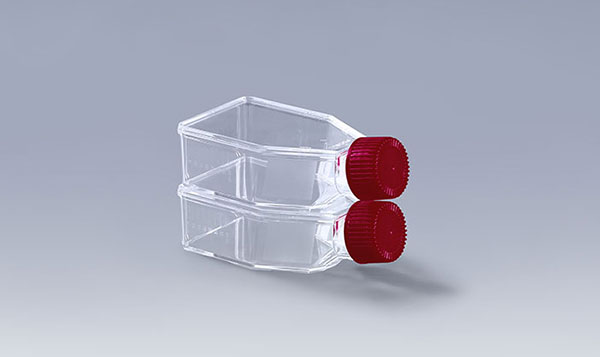
T25 TC-treated Cell Culture Flask
Maintain Consistent Seeding Density
When expanding cells between different flask sizes, seeding density should be based on viable cells per unit of growth area.
For example, moving from a T75 flask to a T225 flask increases the nominal growth surface threefold. Simply transferring the same number of cells may result in an excessively low starting density.
Low seeding density may slow recovery, while excessive density can lead to rapid confluence and changes in cell condition.
Maintaining a defined seeding strategy helps improve consistency between passages before banking.
Avoid Over-Confluence Before Harvest
Waiting until cells are heavily over-confluent is not necessarily the best way to maximize the number of cells available for freezing.
Extended over-confluence can affect:
Cell morphology
Growth behaviour
Detachment
Viability
Recovery after reseeding
Cells should generally be harvested within the appropriate growth phase defined for the specific cell line and process.
The decision to harvest should therefore consider cell condition rather than simply maximizing surface coverage.
Standardize Cell Harvesting
Consistent harvesting is particularly important before cell banking because the harvested population will become the source material for frozen stocks.
For adherent cells grown in tissue culture flasks, variables such as washing, dissociation reagent exposure, detachment time, and mechanical handling should be controlled.
Excessive trypsinization may reduce cell viability or affect subsequent attachment, while incomplete detachment may reduce total recovery.
After harvesting, viable cell count and suspension uniformity should be evaluated before preparation for cryopreservation.
Keep Passage History Under Control
Passage number is an important record during cell bank preparation.
Repeated expansion beyond the established passage range may introduce changes in cell behaviour. Laboratories should therefore record:
Starting passage number
Passage number at each expansion stage
Flask size
Seeding density
Harvest date
Viable cell yield
Operator
Cell culture flask lot number
These records help connect the final frozen bank with its upstream culture history.
Batch Traceability of Cell Culture Flasks
Consumable traceability can also support cell banking documentation.
Recording the lot number of the cell culture flasks used during expansion makes it easier to investigate unexpected results or compare different cell banking campaigns.
Relevant records may include:
Flask catalogue number
Product lot number
TC-treated surface type
Cap configuration
Sterility information
Related quality documents
For quality-sensitive applications, traceability should extend from the starting cells through culture, harvesting, freezing, and storage.
Cell Culture Flask Quality Considerations
When selecting flasks for cell banking preparation, laboratories should evaluate more than flask size.
Important factors include:
TC-treated surface consistency
Sterility
Low endotoxin level
DNase/RNase-free status
Flask flatness
Optical clarity
Cap and filter performance
Packaging integrity
Batch-to-batch consistency
Consistent cell attachment and growth help reduce unnecessary variability during the expansion stages leading to cell banking.
Building a Reproducible Cell Banking Workflow
Cell culture flasks provide a flexible approach for expanding adherent cells before cryopreservation, particularly during early and intermediate scale-up.
FDCELL supplies sterile cell culture flasks in T25, T75, T175, and T225 sizes, with TC-treated and non-treated surfaces and different cap options available.
For cell banking preparation, laboratories should standardize flask size, seeding density, passage number, medium exchange, harvest timing, cell recovery, and lot traceability. Controlling these variables can help create a more consistent cell population before freezing and improve reproducibility when the bank is later recovered.










