Cultured meat, also known as cultivated meat or cell-based meat, is produced by growing animal cells under controlled culture conditions rather than obtaining muscle and fat tissues through conventional animal farming.
One of the first challenges in cultured meat research is obtaining enough cells for subsequent differentiation and tissue formation. Many cell types investigated for cultivated meat, including muscle satellite cells and mesenchymal stromal cells (MSCs), are anchorage-dependent and require a suitable surface for attachment and proliferation.
For this reason, Cell Factory systems and other multilayer culture vessels can play a useful role in cultured meat research, particularly during early-stage cell expansion, process development and seed culture before further scale-up.
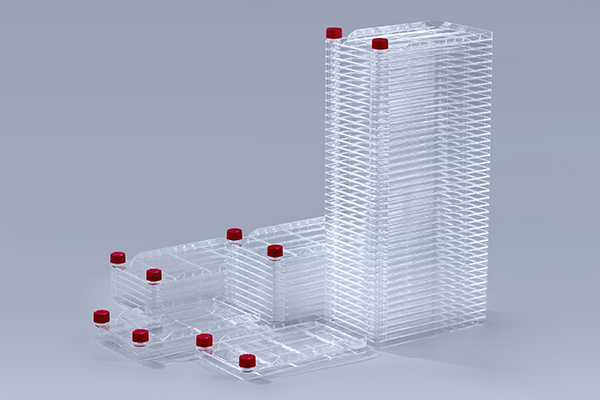
Cell Seeding Density and Medium Volume Guide
Why Is Cell Expansion Important in Cultured Meat?
Cultivated meat production begins with a relatively small population of animal cells. These cells must be expanded significantly before they can be differentiated into muscle, fat or other tissue components.
Depending on the selected cell type, researchers may need to maintain:
Stable cell proliferation
Consistent cell morphology
Appropriate differentiation potential
High cell viability
Reproducible culture conditions
For anchorage-dependent cells, available growth surface becomes an important consideration as cell numbers increase.
Traditional T-flasks are convenient during early research, but handling increasing numbers of individual flasks becomes less practical as the required culture area grows.
This is where multilayer Cell Factory systems may provide an intermediate scale-up option.
Where Can Cell Factory Systems Be Used?
1. Early-Stage Cell Expansion
Cultured meat research may begin with primary cells or established cell lines maintained in conventional culture vessels.
As the cell population increases, researchers can move from T-flasks to larger multilayer vessels to obtain more growth area without operating large numbers of individual flasks.
A Cell Factory therefore provides a relatively straightforward transition from small-scale planar culture to larger adherent cell expansion.
2. Expansion of Anchorage-Dependent Cells
Several cell types investigated in cultivated meat research require attachment to a surface during proliferation.
Examples may include:
Muscle satellite cells
Myoblasts
Mesenchymal stromal cells
Fibroblasts
Adipogenic progenitor cells
A TC-treated Cell Factory provides multiple planar growth surfaces within a compact vessel, allowing adherent cells to expand using culture principles similar to conventional tissue culture flasks.
3. Seed Culture Before Bioreactor Scale-Up
Cell Factory systems can also be considered as part of a seed expansion workflow.
A simplified development pathway may look like:
Cell Isolation → T-Flask → Multilayer Cell Factory → Bioreactor → Differentiation / Tissue Formation
In this type of workflow, the Cell Factory is not necessarily the final production platform. Instead, it can help generate sufficient cell numbers for subsequent transfer to a larger-scale culture system.
The exact seed train will depend on the cell type, culture method and production process.
4. Process Development and Cell Line Evaluation
Before moving into large bioreactors, researchers often need to evaluate different culture conditions.
Cell Factory systems can support studies involving:
Cell growth performance
Seeding density
Culture medium optimization
Cell morphology
Attachment efficiency
Harvesting procedures
Scale-up feasibility
Because the culture environment remains based on a planar attachment surface, the transition from conventional laboratory flasks can be relatively straightforward.
Why Use a Multilayer Cell Factory Instead of More T-Flasks?
Increasing the number of T-flasks is one way to obtain more culture area, but it also increases the number of individual vessels that must be filled, handled, monitored and harvested.
A multilayer Cell Factory combines several growth surfaces within a single vessel.
This can provide:
More culture area within a limited footprint
Fewer individual vessels to handle
Easier transition from laboratory-scale planar culture
More standardized cell expansion
Compatibility with tubing assemblies for fluid transfer
These advantages can make Cell Factory systems useful during research and intermediate-scale development.
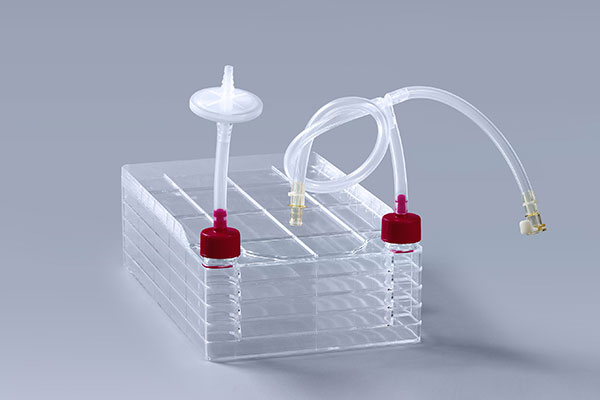
Closed-System Cell Culture for Process Development
As cultured meat research moves toward larger and more standardized processes, fluid handling also becomes increasingly important.
A Closed System Cell Factory can be connected with media bags and collection containers through sterile tubing assemblies, supporting operations such as:
Cell inoculation
Media filling
Medium exchange
Cell harvesting
Closed-system configurations can help reduce repeated manual handling and support more standardized fluid-transfer procedures during scale-up studies.
Cell Factory or Bioreactor?
Cell Factory systems have advantages for adherent cell research, but they also have limitations when very large cell quantities are required.
Industrial cultivated meat production ultimately requires extremely high cell numbers at a cost appropriate for food manufacturing. At these scales, simply adding more planar culture vessels becomes increasingly difficult in terms of footprint, labor, medium handling and process control.
For this reason, large-scale cultivated meat processes are increasingly being developed around technologies such as:
Stirred-tank bioreactors
Microcarrier-based culture
Cell aggregates
Suspension-adapted cells
Scaffolds and other three-dimensional culture systems
Cell Factory systems should therefore be viewed as one tool within the scale-up pathway, rather than a replacement for large-scale bioreactors.
Their strongest potential lies in research, adherent cell expansion, process development and seed preparation.
What Should Researchers Consider When Selecting a Cell Factory?
For cultivated meat research involving adherent cells, several factors should be evaluated:
Culture surface treatment
Available growth area
Cell attachment consistency
Sterility
Layer configuration
Media volume requirements
Ease of cell harvesting
Compatibility with closed-system tubing
Scale-up requirements
The appropriate configuration depends on the cell type and the stage of process development.
FDCELL Cell Factory Systems
FDCELL provides Cell Factory systems for scalable adherent cell culture in 1-layer, 2-layer, 5-layer, 10-layer and 40-layer configurations.
Available options include:
TC-treated culture surfaces
Multiple layer configurations
Sterile, ready-to-use formats
Closed-system tubing assemblies
Batch traceability
Customized connection solutions
For researchers working with anchorage-dependent animal cells, Cell Factory systems can provide additional culture surface for cell expansion during research and process development.
Conclusion
Cultured meat research requires efficient methods for expanding animal cells from small starting populations to much larger quantities.
For anchorage-dependent cells such as muscle satellite cells and MSCs, Cell Factory systems can provide a practical intermediate platform between conventional T-flasks and larger-scale bioreactor processes.
Their value is particularly relevant in early cell expansion, seed culture and process development. As cultivated meat processes move toward industrial production, bioreactors, microcarriers, aggregates and other scalable culture technologies are likely to play a larger role.
Choosing the appropriate culture platform at each stage can help researchers build a more efficient path from laboratory cell culture toward scalable cultivated meat production.










