Selecting the correct cell seeding density and medium volume is critical for successful cell expansion in a Cell Factory system. Incorrect seeding conditions can lead to uneven cell growth, reduced productivity, delayed confluence, or inefficient use of culture media.
Whether you are scaling up Vero cells for vaccine manufacturing, expanding HEK293 cells for viral vector production, or culturing adherent cells for biopharmaceutical applications, understanding the relationship between surface area, seeding density, and medium volume is essential.
This guide provides a practical reference for calculating cell seeding density and medium volume during Cell Factory scale-up.

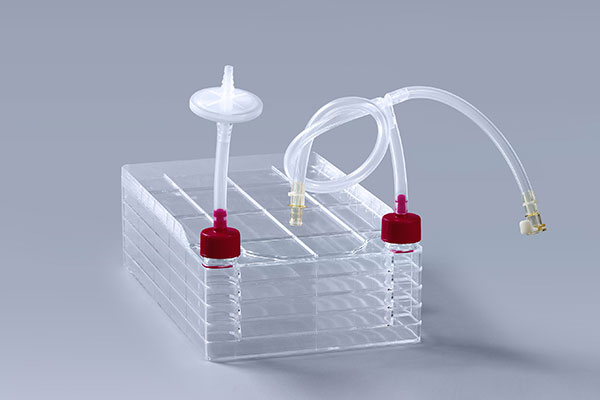
Multilayer Cell Factory
Why Cell Seeding Density Matters in a Cell Factory
Cell seeding density directly influences:
Cell attachment efficiency
Growth kinetics
Time to confluence
Metabolic activity
Product yield and consistency
A seeding density that is too low may prolong culture duration and increase contamination risk, while excessive cell density can result in nutrient depletion and poor cell health.
For most adherent cell lines cultured in a Cell Factory System, optimizing initial cell numbers is one of the most important steps during process development.
Typical Cell Seeding Density for Cell Factory Applications
Recommended starting densities vary depending on the cell type and application.
Typical examples include:
|
Cell Line |
Recommended Seeding Density |
|
Vero Cells |
1.5–3.0 × 10⁴ cells/cm² |
|
MDCK Cells |
2.0–4.0 × 10⁴ cells/cm² |
|
HEK293 Cells (Adherent) |
1.0–2.5 × 10⁴ cells/cm² |
|
CHO Cells (Adherent) |
1.5–3.0 × 10⁴ cells/cm² |
|
Fibroblasts |
0.8–2.0 × 10⁴ cells/cm² |
Actual seeding densities should be optimized according to culture duration, harvest strategy, and target productivity.
Cell Factory Surface Area Reference
Different Cell Factory configurations provide different growth areas.
|
Cell Factory Configuration |
Approximate Growth Area |
|
1 Layer Cell Factory |
632 cm² |
|
2 Layer Cell Factory |
1,264 cm² |
|
5 Layer Cell Factory |
3,160 cm² |
|
10 Layer Cell Factory |
6,320 cm² |
|
25,280 cm² |
Understanding the available surface area is the first step when calculating inoculation volume and total cell requirements.
How to Calculate Required Cell Numbers
The total number of cells required can be estimated using the following equation:
Required Cell Number = Surface Area × Seeding Density
For example, if a 10 Layer Cell Factory with a growth area of 6,320 cm² is inoculated at 2 × 10⁴ cells/cm²:
Required Cell Number = 6,320 × 20,000
Total Cells Required = 1.26 × 10⁸ cells
This calculation allows process development teams to determine upstream seed train requirements before inoculation.
How to Determine Medium Volume
Medium volume in a Multilayer Cell Factory should provide sufficient nutrient supply while maintaining uniform liquid distribution across all layers.
Typical recommendations include:
|
Cell Factory Type |
Recommended Medium Volume |
|
1 Layer |
100–150 mL |
|
2 Layer |
200–300 mL |
|
5 Layer |
500–750 mL |
|
10 Layer |
1,000–1,500 mL |
|
40 Layer |
4,000–6,000 mL |
The optimal volume may vary depending on:
Cell type
Culture duration
Feeding strategy
Oxygen demand
Harvest schedule
Scale-Up Considerations for Vaccine Manufacturing
For vaccine manufacturers utilizing Vero or MDCK cells, maintaining comparable seeding density during scale-up is essential to achieve reproducible virus yields.
When transferring processes from T-flasks or roller bottles to a Cell Factory System, manufacturers should evaluate:
Cell attachment performance
Confluence timing
Nutrient consumption
Metabolite accumulation
Virus productivity
Maintaining similar surface area-to-cell ratios across different culture vessels can significantly reduce process variability.
Why Choose FDCell Cell Factory Systems
FDCell provides high-quality Cell Factory Systems designed for reliable large-scale adherent cell culture.
Features include:
Uniform TC-treated growth surfaces
Multiple configurations from 1-layer to 40-layer
Medical-grade polystyrene materials
Sterile and ready-to-use format
Compatibility with closed-system tubing assemblies
Batch-to-batch consistency for bioprocess applications
Our Cell Factory products support vaccine manufacturing, cell therapy research, viral vector production, and biopharmaceutical process development worldwide.
Conclusion
Accurate calculation of cell seeding density and medium volume is fundamental for successful Cell Factory scale-up.
By optimizing inoculation conditions early in process development, manufacturers can improve cell growth consistency, shorten production timelines, and maximize productivity in large-scale adherent cell culture applications.
Whether you are developing vaccines, biologics, or cell therapy products, a well-designed Cell Factory System provides a reliable platform for efficient scale-up and commercial manufacturing.










