Selecting a reliable Cell Factory supplier is not only a purchasing decision. For biopharmaceutical companies, vaccine manufacturers, cell therapy research teams, and distributors, supplier qualification directly affects process stability, contamination control, batch consistency, and long-term supply security. A multilayer cell factory is often used for adherent cell expansion, virus production, vaccine research, and large-scale cell culture processes, so every detail from raw material selection to surface treatment and packaging should be carefully evaluated.
This Cell Factory Supplier Qualification Checklist can help procurement teams, quality departments, process development teams, and distributors assess whether a supplier is suitable for long-term cooperation.
1. Manufacturing Capability and Production Environment
A qualified cell factory manufacturer should have a stable production system rather than only trading capability. Before confirming cooperation, buyers should check whether the supplier has its own production facility, cleanroom environment, automated equipment, and process control procedures.
Key points to review:
Does the supplier manufacture cell factories in-house?
Are the products produced in controlled cleanrooms?
Is there automated or semi-automated production to reduce manual contact?
Are personnel, materials, and production flows separated and controlled?
Can the supplier support stable batch-to-batch production for long-term orders?
For large-volume procurement, production capacity is especially important. A supplier may provide samples quickly, but long-term supply requires stable molding, assembly, inspection, sterilization, and packaging capacity. For distributors, this also affects delivery time, inventory planning, and customer satisfaction.
2. Product Range and Application Matching
Different cell culture processes require different specifications. A professional cell factory supplier should provide clear product options and help customers select suitable formats based on cell type, culture scale, liquid handling method, and downstream process requirements.
Common evaluation points include:
Available layer options, such as 10-layer and 40-layer cell factories
TC-treated surface for adherent cell culture
Suitable design for Vero, MDCK, HEK293, CHO, MSC, and other adherent cells
Compatibility with manual operation or closed liquid transfer systems
Options for filling, harvesting, and closed-system connection
Packaging formats suitable for research, pilot-scale, or production use
For adherent cell expansion, a multilayer cell factory can help increase growth surface area while saving incubator space. However, the supplier should be able to explain product specifications clearly, including growth area, working volume, recommended filling volume, cap type, tubing compatibility, and handling precautions.

3. Raw Material and Product Design
Raw material quality is a basic but critical factor in cell culture consumables. Buyers should ask the supplier to provide information about the resin, product structure, and material compliance.
A cell factory used in bioprocess applications should be made from high-quality, transparent, and cell-culture-grade material. The material should support microscopic observation, stable cell attachment, and reliable performance during routine handling.
Checklist items:
Is the raw material suitable for cell culture applications?
Is the product transparent enough for cell observation?
Is the structure designed for uniform liquid distribution?
Are the layers flat and consistent?
Are the ports and caps designed for secure connection?
Does the supplier provide technical data or quality documentation?
A well-designed cell factory should help reduce operational variation during seeding, medium exchange, washing, and harvesting. Poor flatness, unstable sealing, or inconsistent layer structure may affect cell distribution and process reproducibility.
4. Surface Treatment Consistency
For adherent cell culture, TC treatment is one of the most important qualification items. A reliable TC-treated cell factory should support uniform cell attachment and growth across different layers and different production batches.
When evaluating a supplier, buyers should ask:
What type of surface treatment process is used?
Is the TC-treated surface tested regularly?
Does the supplier monitor hydrophilicity or contact angle?
Can the supplier provide batch consistency data?
Are cell attachment and growth performance evaluated?
Surface consistency is especially important for vaccine production, viral vector research, stem cell expansion, and process development. If the surface treatment is unstable, customers may experience uneven cell attachment, lower yield, or inconsistent harvest results.
5. Sterility Assurance and Contamination Control
Sterility is a non-negotiable requirement for cell culture consumables. A qualified cell factory supplier should have a clear contamination control system covering production, assembly, packaging, sterilization, storage, and shipment.
Important questions include:
Are the cell factories supplied sterile?
What sterilization method is used?
Is every batch tested or released according to internal quality procedures?
Are products DNase/RNase-free where applicable?
Is endotoxin level controlled?
Are packaging materials suitable for sterile protection during transportation?
For biopharma and vaccine customers, sterility assurance is closely connected with risk management. A supplier should not only state that products are sterile, but also provide supporting quality control procedures and traceability.
6. Batch Traceability and Quality Documentation
Traceability is an essential part of supplier qualification. Buyers should confirm whether each batch can be traced from raw material to finished product.
A professional cell factory manufacturer should be able to provide:
Lot number information
Production batch records
Inspection records
Sterilization records
Certificate of Analysis or quality certificate when required
Retained sample management
Complaint and corrective action procedures
For distributors, complete documentation also helps build trust with end users. When customers from biopharmaceutical companies or research institutions request product information, clear quality documents can make communication much easier.
7. Packaging, Transportation, and Storage
Cell factories are large-volume consumables, so packaging strength and transportation protection should be reviewed carefully. Even if the product itself is well manufactured, poor packaging may lead to deformation, leakage risk, damaged cartons, or compromised sterile barriers.
Checklist items:
Is the individual packaging strong and clean?
Is the outer carton suitable for export transportation?
Are product labels clear and traceable?
Are storage conditions clearly indicated?
Can the supplier support bulk shipment and distributor inventory needs?
Are pallets, cartons, and packaging formats suitable for international shipping?
For overseas buyers, packaging reliability is directly related to receiving quality. A good supplier should understand export requirements and provide stable packing standards for long-distance transportation.
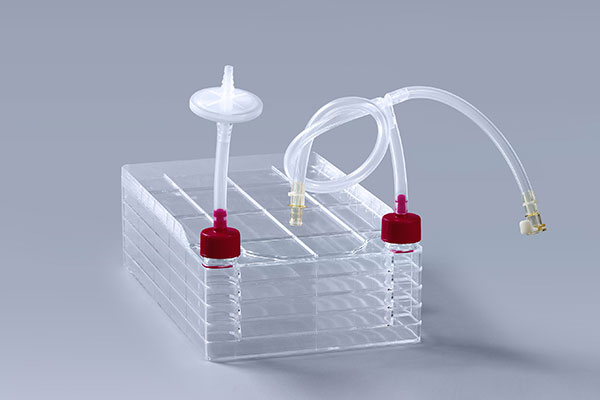
Closed System Cell Factory with Tube
8. OEM, Private Label, and Distributor Support
For distributors and brand owners, supplier qualification should also include commercial support. A cell factory supplier with OEM or private label capability can help partners develop their own local market more efficiently.
Key points to evaluate:
Can the supplier provide OEM or private label service?
Is customized packaging available?
Can the supplier provide product images, catalogs, and technical documents?
Does the supplier support distributor pricing and long-term cooperation?
Can the supplier provide samples for local customer testing?
Is communication timely and professional?
For distributors, the best supplier is not only a manufacturer, but also a long-term partner who can support market development, technical communication, and stable supply.
9. Technical Communication and After-Sales Response
Supplier qualification is not complete without evaluating communication quality. When customers ask about cell type compatibility, liquid handling, closed transfer, recommended working volume, or sample testing, the supplier should respond clearly and professionally.
A reliable supplier should be able to support questions such as:
Is the cell factory suitable for MSC, Vero, MDCK, or HEK293 cells?
What is the recommended filling volume?
Can the product be used with tubing for closed liquid transfer?
How should the cell factory be handled during seeding and harvesting?
What documents can be provided for internal evaluation?
How are quality complaints handled?
Fast and accurate communication helps reduce misunderstanding before purchase and supports smoother product validation after delivery.
10. Final Supplier Qualification Checklist
Before selecting a cell factory supplier, buyers can use the following checklist:
In-house manufacturing capability
Controlled cleanroom production
Stable supply capacity
Complete product specifications
TC-treated surface consistency
Sterility assurance
Endotoxin and contamination control
Batch traceability
Quality documentation
Reliable packaging for export
Technical support capability
OEM or private label support
Sample availability
Distributor cooperation policy
Long-term supply stability
Conclusion
Choosing a Cell Factory supplier should not be based only on price. For cell culture applications, buyers should evaluate manufacturing capability, cleanroom control, TC-treated surface consistency, sterility assurance, documentation, packaging, technical support, and long-term supply reliability.
A qualified multilayer cell factory manufacturer can help customers reduce sourcing risk, improve process consistency, and support stable adherent cell culture scale-up. For biopharmaceutical companies, vaccine manufacturers, research institutions, and distributors, a complete supplier qualification checklist is an effective way to identify reliable partners and build long-term cooperation.










