For adherent cell culture, the growth surface is more than a physical support. Its surface properties influence how culture medium interacts with the vessel and can affect the environment in which cells attach and spread.
For polystyrene cell culture vessels, surface treatment is commonly used to modify the originally hydrophobic surface and improve its wettability. One method used to characterize this change is contact angle measurement.
Contact angle provides useful information about the physical condition and consistency of a treated surface. However, it should be interpreted as a surface characterization parameter—not as a stand-alone prediction of cell growth.

cell culture flask
What Does Contact Angle Measure?
Contact angle describes the angle formed where a liquid droplet meets a solid surface.
In simplified terms:
A higher contact angle generally indicates a more hydrophobic surface.
A lower contact angle generally indicates greater surface wettability.
Untreated polystyrene is naturally hydrophobic. After tissue-culture surface treatment, changes in surface chemistry increase wettability, allowing aqueous culture media to interact more readily with the growth surface.
This is why contact angle can be useful when evaluating TC-treated cell culture surfaces.
Why Surface Wettability Matters in Adherent Cell Culture
Adherent cells do not simply attach to bare plastic in isolation. Once culture medium contacts the vessel, interactions among the surface, medium components, proteins, and cells contribute to the attachment environment.
Surface wettability can influence how liquid spreads across the culture area and reflects changes introduced by surface treatment.
A suitably treated surface can help provide a more consistent environment for adherent culture, while significant differences in surface properties may indicate variation that deserves further investigation.
For manufacturers of TC-treated cell culture flasks, contact angle testing can therefore serve as one tool for monitoring whether the surface treatment process is producing consistent physical characteristics.
Contact Angle as a Process Consistency Indicator
One of the most useful roles of contact angle measurement is not simply determining whether a surface is "hydrophilic" or "hydrophobic," but monitoring consistency.
For example, contact angle data may be used when comparing:
Different production lots
Different positions across treated surfaces
Results before and after process adjustments
Surface treatment consistency over time
Samples produced under different manufacturing conditions
When the measurement method is controlled, changes in contact angle can provide an indication that the surface condition has changed.
This makes the test particularly useful as part of manufacturing process monitoring and lot-to-lot evaluation.
Measurement Conditions Matter
Contact angle values should not be interpreted without considering how the measurement was performed.
Results can be influenced by factors such as:
Test liquid
Droplet volume
Measurement timing
Surface cleanliness
Temperature and environmental conditions
Sample location
Instrument and analysis method
For this reason, comparing contact angle values from different suppliers or laboratories without understanding the test conditions may lead to misleading conclusions.
For internal quality monitoring, a standardized method is particularly important so that changes in measured values are more likely to reflect actual changes in the surface rather than differences in testing technique.
A Lower Contact Angle Is Not Automatically Better
It can be tempting to assume that the lowest possible contact angle will always produce the best cell attachment.
The relationship is more complicated.
Cell attachment and growth depend on multiple interacting factors, including the characteristics of the cell line, culture medium, proteins at the interface, surface chemistry, seeding conditions, and culture procedure.
Contact angle primarily describes surface wettability. It does not directly measure:
Cell attachment efficiency
Cell spreading
Cell morphology
Proliferation rate
Viable cell yield
Therefore, an acceptable contact angle should be viewed as evidence that the treated surface meets a defined physical characteristic—not proof by itself that every cell type will achieve optimal biological performance.
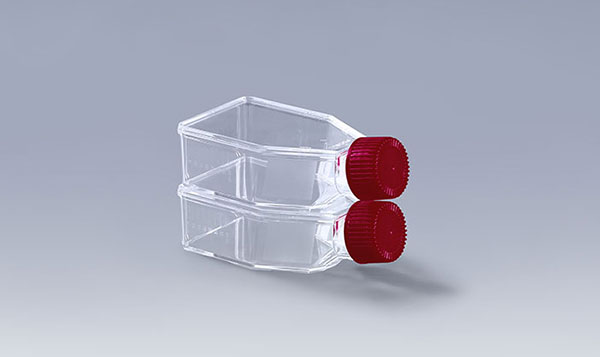
T25 TC-treated Cell Culture Flask
Physical Testing Should Be Connected With Biological Performance
A stronger evaluation strategy combines physical surface characterization with biological testing.
Contact angle can answer:
“Is the physical wettability of the treated surface consistent?”
Cell-based evaluation can answer:
“Does the surface support the expected biological performance under defined culture conditions?”
Depending on the intended application, biological comparisons may consider parameters such as cell attachment, morphology, spreading, proliferation, confluence, and harvest yield.
When physical and biological data are evaluated together, they provide a more complete picture of cell culture surface performance.
Why This Matters When Comparing Cell Culture Flasks
When qualifying a new cell culture flask or comparing suppliers, visual appearance and nominal growth area alone provide limited information about the culture surface.
For TC-treated products, surface characterization can provide additional evidence about manufacturing consistency.
However, buyers should avoid evaluating a flask based on a single contact angle value. A more meaningful assessment considers the manufacturer's treatment control, lot consistency, test methodology, traceability, and relevant biological performance data together.
This is especially important when cell culture consumables are being evaluated for established biopharmaceutical or research workflows where unexpected changes in cell behavior may affect downstream process results.
From Surface Wettability to Consistent Cell Culture Performance
Contact angle measurement is a useful tool for characterizing the wettability of TC-treated cell culture surfaces and monitoring surface-treatment consistency.
Its value is greatest when the measurement is performed under controlled conditions and interpreted within a broader quality framework.
Rather than asking only whether a contact angle is "low enough," a more useful question is:
Is the surface treatment consistent, controlled, and supported by appropriate biological performance data?
For adherent cell culture applications, this combination of physical characterization and biological evaluation provides a stronger basis for assessing the consistency of a cell culture surface.










