Oxygen availability is an important factor in many suspension culture processes. Even when the same medium, inoculation density, and cell line are used, differences in oxygen transfer can lead to changes in growth rate, cell density, metabolism, and product yield.
In an Erlenmeyer Shake Flask, oxygen is mainly transferred from the flask headspace into the culture medium through the gas-liquid interface. Understanding the factors that affect oxygen transfer rate (OTR) can therefore help laboratories establish more consistent shake flask culture conditions.
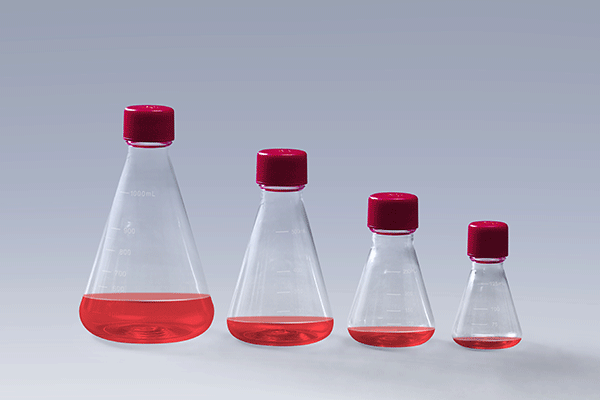
What Determines Oxygen Transfer in a Shake Flask?
Unlike a stirred bioreactor, an Erlenmeyer Shake Flask normally has no active aeration or dissolved oxygen control. Oxygen transfer depends on the movement of the liquid during orbital shaking and the exchange of gas through the flask closure.
A simplified relationship is often expressed as:
OTR = kLa × (C − C)*
where kLa represents the volumetric mass transfer coefficient, C* is the equilibrium oxygen concentration, and C is the actual dissolved oxygen concentration in the culture.
In practical shake flask work, researchers do not necessarily need to calculate OTR for every culture. What matters is understanding which operating conditions can change oxygen availability.
Working Volume Has a Direct Effect on Oxygen Transfer
Fill volume is one of the easiest parameters to change—and one of the easiest to overlook.
As the working volume in an Erlenmeyer Flask increases, the ratio between liquid volume and available gas-liquid surface area changes. A heavily filled flask generally provides less efficient aeration than the same flask operated at a lower working volume.
This is why oxygen-demanding cultures often use relatively low fill volumes. However, simply reducing the volume as much as possible is not always the answer. The appropriate volume should also consider evaporation, shear sensitivity, process scale, and the characteristics of the cultured cells.
When comparing experiments, keeping the flask size and working volume consistent is important.
Shaking Speed and Orbit Should Be Considered Together
Increasing shaking speed generally increases liquid movement and can improve oxygen transfer. However, rpm alone does not fully describe the shaking conditions.
The orbit diameter of the shaker also affects liquid movement. For example, two cultures operated at the same rpm on shakers with different orbit diameters may experience different mixing and oxygen transfer conditions.
This becomes particularly important when a process is transferred between laboratories or equipment platforms. Recording only “150 rpm,” for example, may not provide enough information to reproduce the original culture conditions.
For process development, shaker speed, orbit diameter, flask size, and working volume should be considered as a system rather than as independent parameters.
Vent Cap Performance Matters
Gas must first enter the flask before oxygen can reach the culture medium. The closure of an Erlenmeyer Shake Flask therefore plays an important role in overall gas transfer.
Vent caps equipped with hydrophobic membranes allow gas exchange while helping maintain a sterile barrier. Membrane material, effective venting area, and cap construction can all influence gas exchange performance.
For active aerobic cultures, a vented flask is generally more appropriate than a fully sealed flask. A seal cap may be useful for media preparation, mixing, or storage, but it can restrict the gas exchange required during cell growth.
Oxygen Demand Changes During Culture
Oxygen demand is not constant throughout a culture run.
During the early growth phase, cell density may be relatively low and oxygen supply sufficient. As biomass increases, oxygen consumption can rise rapidly. A shake flask condition that appears adequate at the beginning of culture may become oxygen-limited later.
This is particularly relevant for high-density microbial cultures and rapidly expanding suspension cells.
Signs associated with inadequate oxygen availability may include slower growth, altered metabolism, lower final cell density, or unexpected differences between otherwise similar cultures. These observations should not automatically be attributed to the flask itself; medium composition, cell condition, temperature, pH, and other process parameters should also be investigated.
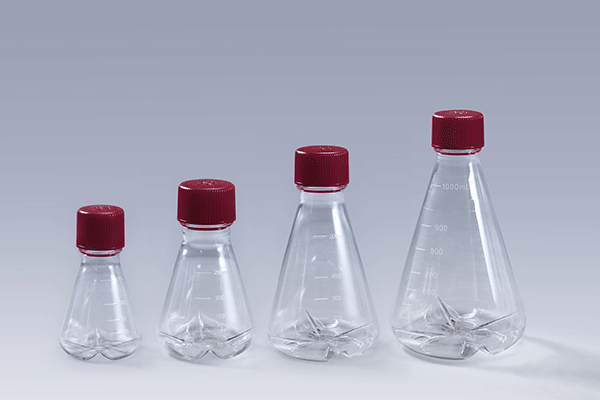
User Guide for Erlenmeyer Shake Flask
Flask Geometry and Manufacturing Consistency
The shape of an Erlenmeyer Flask determines how the liquid moves during orbital shaking. Changes in flask geometry can alter wave formation, mixing, and gas-liquid surface area.
For this reason, switching between different flask designs should not always be treated as a simple one-to-one replacement, particularly in established processes.
For biopharmaceutical process development, attention should also be paid to consistency between production lots. Variations in flask dimensions, closure fit, or vent membrane performance may introduce an additional variable into a process that has already been optimized.
This becomes increasingly important when shake flask data are used to support seed train development or subsequent scale-up.
What Should Be Controlled When Comparing Shake Flask Results?
When investigating oxygen-related differences or qualifying a new Erlenmeyer Shake Flask, it is useful to keep the following parameters documented and controlled:
Flask nominal volume and actual working volume
Shaking speed
Shaker orbit diameter
Vent cap configuration
Flask geometry
Incubator temperature and humidity
Cell density and culture duration
For critical applications, comparing growth curves, viability, cell density, and relevant productivity indicators under the same operating conditions can provide more useful information than evaluating the flask only by its physical specifications.
From Culture Parameter to Consumable Qualification
For routine laboratory experiments, oxygen transfer may simply be considered part of culture optimization. In biopharmaceutical development and scale-up, however, it can also become a consumable qualification issue.
When an established process is transferred to another flask size or an alternative Erlenmeyer Shake Flask supplier is evaluated, matching nominal capacity alone may not guarantee equivalent culture performance. Flask geometry, cap ventilation, material, manufacturing consistency, and actual culture results should be considered together.
A well-controlled evaluation can help determine whether a new shake flask can be introduced without creating unnecessary variability in the upstream process.
Conclusion
Oxygen transfer in an Erlenmeyer Shake Flask is influenced by more than shaking speed alone. Working volume, shaker orbit, cap ventilation, flask geometry, cell density, and culture duration all contribute to the oxygen environment experienced by the cells.
Understanding these relationships helps researchers optimize culture conditions, but it is equally important when transferring processes, scaling up cultures, or evaluating alternative shake flask suppliers.
For laboratories and biopharmaceutical teams, treating the Erlenmeyer Flask as part of the overall culture system—not simply as a container—can support better reproducibility from early development through scale-up.










