Seeding density is one of the most important variables in adherent cell culture. Even when the same medium, cell line, and cell culture flask are used, different starting cell densities can lead to very different growth patterns.
Too few cells may result in slow recovery and delayed confluence, while too many cells may cause rapid overcrowding and early nutrient depletion. Choosing an appropriate seeding density helps maintain more consistent cell attachment, morphology, proliferation, and final cell yield.

cell culture flask
What Is Seeding Density?
Seeding density refers to the number of viable cells introduced into a defined culture area, often expressed as cells per cm².
For cell culture flasks, growth area changes significantly between formats:
T25: 25 cm²
T75: 75 cm²
T175: 175 cm²
T225: 225 cm²
This means that the same total number of cells will produce very different starting densities in different flask sizes.
When changing flask formats, users should therefore consider cell number relative to growth area rather than simply transferring the same volume of cell suspension.
What Happens When Seeding Density Is Too Low?
Low-density cultures may take longer to establish.
Possible results include:
Slow cell attachment and spreading
Delayed proliferation
Uneven cell distribution
Longer time to reach target confluence
Greater variation between cultures
Changes in morphology for density-sensitive cells
Some cells depend on signals from neighbouring cells for efficient growth. If cells are seeded too far apart, recovery and proliferation may be slower even when medium and incubation conditions are appropriate.
Low seeding density can be particularly important during post-thaw recovery and early passage culture, when the available viable cell number may already be limited.
What Happens When Seeding Density Is Too High?
More cells do not always mean better growth.
When the initial density is too high, cells may reach confluence earlier than expected. This can increase competition for nutrients and available surface area.
High-density cultures may show:
Rapid confluence
Cell crowding
Increased nutrient consumption
Faster changes in medium condition
Altered morphology
Reduced consistency at harvest
Need for earlier passage
For contact-sensitive cell lines, prolonged over-confluence may also affect cell behaviour and subsequent passages.
The goal is therefore not to maximize the initial cell number, but to establish a density that supports predictable growth.
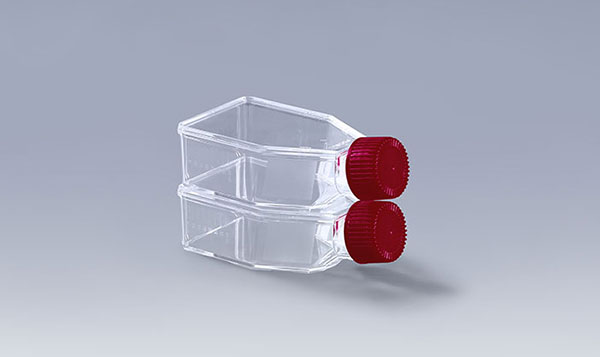
T25 TC-treated Cell Culture Flask
Seeding Density and Uneven Confluence
Uneven confluence is sometimes attributed to the TC-treated flask surface, but the original seeding pattern should also be reviewed.
If the cell suspension is not uniform, or if cells begin settling before dispensing is complete, different parts of the flask may receive different numbers of cells.
Other factors include:
Cell clumps
Air bubbles
Uneven medium coverage
Excessive flask movement after seeding
Poor cell distribution across the growth surface
At lower seeding densities, these differences can become particularly visible because small variations in initial cell numbers may produce large differences later in culture.
Seeding Density During Flask Scale-Up
When moving from a smaller flask to a larger format, maintaining a comparable seeding density per cm² provides a useful starting point.
For example, moving from a T75 flask to a T225 flask increases the nominal growth area threefold. If the same target seeding density is maintained, approximately three times as many viable cells would be required for the T225 flask.
However, direct mathematical scale-up is only a starting point. Users should also consider:
Cell recovery after harvesting
Attachment efficiency
Cell viability
Medium volume
Growth rate
Target confluence
Required harvest time
Actual culture performance should be evaluated after changing formats.
How to Improve Seeding Consistency
A standardized seeding procedure helps reduce flask-to-flask variation.
Key practices include:
Count viable cells before seeding
Calculate cell number based on growth area
Prepare a uniform cell suspension
Minimize cell clumping
Mix gently between multiple flask inoculations
Avoid excessive air bubbles
Distribute cells evenly across the surface
Keep the flask level during initial attachment
Record flask size, seeding density, and product lot
These records make it easier to compare results between experiments, operators, flask sizes, and product batches.
Finding the Right Seeding Density
There is no universal seeding density suitable for every cell line. The appropriate range depends on cell type, growth characteristics, experimental purpose, and culture duration.
When establishing a new process, laboratories can compare several starting densities while keeping other variables consistent. Cell attachment, morphology, confluence, growth rate, and viable cell yield can then be used to determine a suitable working range.
FDCELL supplies sterile cell culture flasks in T25, T75, T175, and T225 sizes, with TC-treated and non-treated surfaces and different cap configurations available.
Maintaining an appropriate seeding density when moving between flask sizes can help improve culture consistency and make adherent cell scale-up more predictable.










