Cell aggregation is common in suspension culture, but excessive or irregular clumping can make a process difficult to control. Large aggregates may create uneven access to oxygen and nutrients, interfere with sampling and cell counting, and increase variability between cultures.
When aggregation appears in an Erlenmeyer Shake Flask, simply increasing the shaking speed is rarely the complete solution. Cell characteristics, inoculation conditions, medium composition, hydrodynamics, and flask configuration all need to be considered.
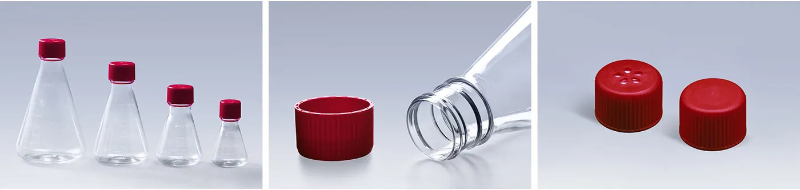
Why Do Cells Aggregate in Shake Flask Culture?
Some suspension cell lines naturally grow as small clusters, so aggregation is not always a sign of poor culture performance. The problem arises when aggregate size becomes excessive, changes unexpectedly, or begins to affect viability and growth.
Common contributors include:
High starting cell density
Incomplete cell dispersion during inoculation
Insufficient agitation
Changes in medium composition
Accumulation of extracellular material or cell debris
Increasing culture density
Differences in flask geometry or operating conditions
The first step is therefore to determine whether the observed aggregation is normal for the cell line or represents a change from the established culture pattern.
Start with the Inoculum
Aggregation can begin before the cells enter the Erlenmeyer Shake Flask.
If the inoculum already contains large clusters, transferring it into a larger flask may simply carry the problem forward. Uneven inoculation can also produce different starting conditions between parallel cultures.
Before scale-up, check the condition of the seed culture, including viability, cell concentration, and aggregate distribution. Where appropriate for the cell line and process, the inoculum should be prepared consistently so that each flask begins with a comparable cell population.
This becomes particularly important during seed train expansion, where variation introduced at an early stage can become more pronounced at later stages.
Review Shaking Conditions—But Don't Focus on RPM Alone
Agitation keeps cells suspended and influences how frequently cells interact with one another. If agitation is insufficient, cells may settle or remain in prolonged contact, encouraging the formation of larger aggregates.
Increasing rpm may improve suspension, but excessive agitation can create another problem: shear stress.
The appropriate conditions depend on more than shaking speed. Shaker orbit, Erlenmeyer Flask size, working volume, and cell characteristics all influence the hydrodynamic environment.
Instead of asking only, “What rpm should we use?”, a better question is:
Does the current flask-and-shaker combination provide enough mixing to maintain the desired aggregate size without compromising cell viability?
Check the Working Volume
Working volume changes the liquid movement inside an Erlenmeyer Shake Flask.
When a flask is filled too heavily, liquid circulation may become less effective under a given shaking condition. This can create less uniform suspension and increase cell-to-cell contact in some cultures.
Reducing the working volume can alter mixing and oxygen transfer, but it should be evaluated experimentally rather than treated as a universal solution. Changes in fill volume may also affect evaporation, shear, and other process conditions.
For comparative experiments, keep working volume consistent and document it together with flask size, shaking speed, and orbit.
Consider Cell Density and Culture Duration
Aggregation often changes as a culture progresses.
At higher cell densities, the frequency of cell-to-cell interactions increases. Nutrient depletion, metabolite accumulation, declining viability, and the presence of cellular debris can further alter aggregation behavior.
If large clusters consistently appear late in culture, the issue may not originate from the Erlenmeyer Shake Flask itself. It may indicate that the culture has reached a density or duration at which the existing operating conditions are no longer optimal.
Monitoring aggregate size together with viable cell density and viability can provide a clearer picture than observing clumping alone.
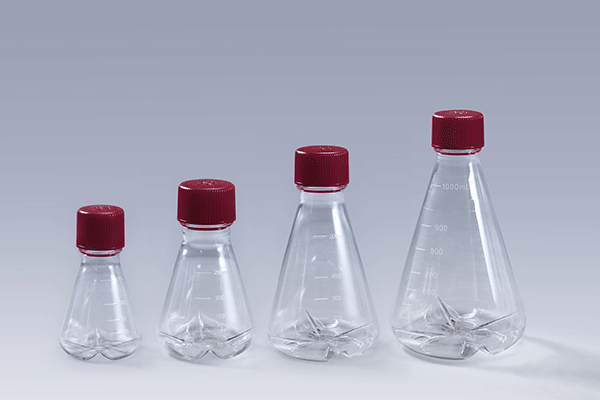
User Guide for Erlenmeyer Shake Flask
Don't Ignore Medium and Cell-Line Effects
Culture medium can influence cell-cell interactions. Changes in media formulation, supplements, serum content, or raw-material lots may alter aggregation even when flask conditions remain unchanged.
Likewise, different cell lines—and sometimes different clones of the same cell type—can show very different aggregation tendencies.
This is why troubleshooting should avoid changing several parameters simultaneously. If medium, flask, working volume, and shaking speed are all changed at once, it becomes difficult to identify what actually improved or worsened the culture.
Can Flask Design Influence Aggregation?
The physical design of an Erlenmeyer Shake Flask affects liquid movement during orbital shaking. Flask diameter, bottom geometry, working volume, and shaker orbit collectively determine the mixing pattern experienced by the cells.
For an established suspension process, changing to a different flask design may therefore require comparative evaluation rather than assuming equivalent performance based only on nominal capacity.
When evaluating a new flask or supplier, it can be useful to compare:
Aggregate size and distribution
Viable cell density
Cell viability
Growth profile
Culture appearance at defined time points
For process development teams, these culture-based results are often more meaningful than comparing flask dimensions alone.
A Practical Troubleshooting Approach
When unexpected aggregation occurs, investigate the process systematically.
Start with the cell source and inoculum, then review cell density, medium, working volume, shaking conditions, shaker orbit, and culture duration. If the problem coincides with a change in consumables, compare the previous and current Erlenmeyer Shake Flask under otherwise identical conditions.
Changing one major variable at a time makes it easier to identify the actual cause and establish a reproducible solution.
From Aggregation Control to Process Consistency
For early research, cell aggregation may be treated primarily as a culture optimization issue. During biopharmaceutical process development, however, maintaining a defined and reproducible cell state becomes increasingly important.
If an Erlenmeyer Flask is part of a seed train, inconsistent aggregation can affect inoculum quality entering the next expansion stage. This makes flask selection, operating parameters, and lot-to-lot consistency relevant not only to R&D teams but also to process development and consumable qualification.
When qualifying a new shake flask supplier or transferring a process between flask sizes, aggregation behavior can therefore be included as one of the performance attributes assessed during side-by-side culture studies.
Conclusion
Reducing cell aggregation in Erlenmeyer Flask culture requires more than adjusting a single parameter. Inoculum condition, cell density, medium, working volume, agitation, shaker orbit, flask geometry, and culture duration can all contribute to aggregate formation.
The goal is not necessarily to eliminate every cell cluster. Instead, culture conditions should maintain aggregation within a range appropriate for the specific cell line and process.
By monitoring aggregation alongside growth and viability—and controlling the Erlenmeyer Flask culture conditions consistently—researchers can establish more reproducible suspension cultures and a more reliable foundation for subsequent scale-up.










