Air bubbles may seem like a minor issue during Cell Factory culture, but in multilayer vessels they can interfere with liquid distribution and reduce the effective contact between culture medium and the growth surface. When bubbles remain over the culture area, they may contribute to uneven cell attachment or inconsistent growth between different regions.
For large-scale adherent cell culture, controlling bubble formation should therefore be part of a standardized Cell Factory operating procedure.

Cell Seeding Density and Medium Volume Guide
Why Do Bubbles Form in a Cell Factory?
Bubbles can be introduced at several stages of the culture process. Common causes include:
Rapid filling of culture medium
Air remaining inside tubing before transfer
Improper Cell Factory positioning during filling
Excessive agitation or movement
Air entering during medium exchange
High transfer rates during pumping
The risk can become more noticeable in multilayer Cell Factory systems, where medium needs to be distributed evenly across multiple growth surfaces.
How Can Bubbles Affect Cell Culture?
The main concern is not simply the presence of air inside the vessel. Cell Factory systems require a gas phase for normal operation. The problem is unwanted bubbles trapped within the culture medium or over the growth surface.
These bubbles can temporarily prevent medium from contacting part of the culture surface. During cell seeding, this may contribute to uneven cell distribution or attachment.
Persistent or excessive bubbles may also complicate:
Uniform media distribution
Microscopic observation
Medium exchange
Cell harvesting
Reproducibility between batches
For this reason, bubble control is particularly important during cell seeding and other fluid-transfer steps.
1. Use a Controlled Filling Rate
Rapid media transfer can increase turbulence and introduce unnecessary bubbles.
During filling, use a controlled and consistent flow rate appropriate for the vessel, tubing assembly and transfer method. Avoid allowing the medium to splash or foam as it enters the Cell Factory.
When using a pump, the operating conditions should be established according to the validated process rather than simply using the highest possible transfer speed.
2. Prime the Tubing Before Fluid Transfer
For a Closed System Cell Factory, air remaining in the tubing can be transferred directly into the culture vessel.
Where appropriate for the process design, priming the tubing with medium before filling can help minimize the amount of air entering the Cell Factory.
Operators should also inspect:
Tubing connections
Clamps
Connectors
Pump installation
Media bag connections
A properly configured tubing assembly supports smoother fluid transfer and more consistent operation.
3. Follow the Correct Filling and Distribution Procedure
Multilayer Cell Factory systems require specific positioning and handling to distribute liquid across the layers.
After filling, the vessel may need to be positioned or moved according to the manufacturer's operating instructions so that medium and cells are distributed across the available culture surfaces.
Avoid unnecessary shaking or abrupt movement. Excessive agitation can create additional bubbles and may also disturb cell distribution during seeding.
4. Reduce Air Introduction During Medium Exchange
Bubble control should continue throughout the culture process.
During medium exchange, air can enter the system when spent medium is removed and fresh medium is introduced.
To minimize this risk:
Maintain controlled transfer conditions.
Avoid unnecessary interruption of fluid flow.
Check tubing connections before transfer.
Minimize foaming during filling.
Follow a consistent vessel-handling procedure.
For larger production processes, a standardized closed-system workflow can make these steps easier to reproduce.
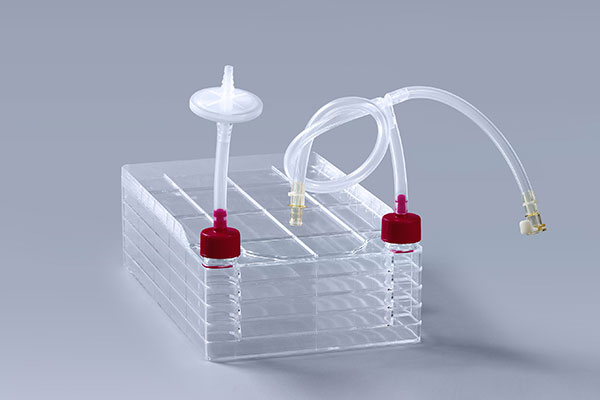
Closed System Cell Factory
5. Check for Bubbles Before Incubation
After cell seeding and medium distribution, inspect the Cell Factory according to the established operating procedure before incubation.
If significant bubbles are visible over the culture area, follow the validated handling procedure to redistribute the liquid and move trapped bubbles away from critical growth surfaces.
This step is especially important during cell seeding because uniform initial attachment helps establish more consistent growth across the vessel.
Closed-System Fluid Transfer Can Help
For applications involving repeated media transfer, closed-system Cell Factory workflows can help reduce unnecessary manual operations.
A customized tubing assembly can connect the Cell Factory with media bags, collection containers and other process components, supporting controlled fluid transfer during:
Cell inoculation
Media filling
Medium exchange
Cell harvesting
However, a closed system does not automatically eliminate bubbles. Tubing design, priming, transfer rate and operator procedures still need to be optimized.
Standardize Bubble Control During Scale-Up
A procedure developed for a small culture vessel may need adjustment when moving to a 10-layer or 40-layer Cell Factory.
As culture scale increases, manufacturers should standardize factors such as fluid transfer, vessel positioning, tubing configuration and operator handling.
Documenting these procedures can help reduce process variability and improve consistency between batches.
FDCELL Cell Factory Systems
FDCELL provides Cell Factory systems in 1-layer, 2-layer, 5-layer, 10-layer and 40-layer configurations for scalable adherent cell culture.
Available solutions include TC-treated culture vessels and customized closed-system tubing assemblies for media transfer, cell inoculation and harvesting.
Conclusion
Reducing bubble formation in Cell Factory culture starts with careful fluid handling. Controlled filling, tubing priming, proper vessel positioning and standardized medium exchange procedures can all help minimize unwanted bubbles.
For large-scale adherent cell culture, bubble control should be considered part of the overall Cell Factory workflow rather than a single troubleshooting step. A consistent operating procedure can support more uniform cell attachment, reliable fluid distribution and better batch-to-batch reproducibility.










