Moving from 2L to 5L roller bottles may look like a simple increase in vessel size, but adherent cell culture cannot always be scaled by volume alone.
A larger roller bottle changes the available growth area, total cell requirement, medium distribution, bottle weight, and interaction with the roller apparatus. For vaccine production and other biopharmaceutical applications, several process parameters should therefore be reviewed before transferring an established 2L culture directly to a 5L format.
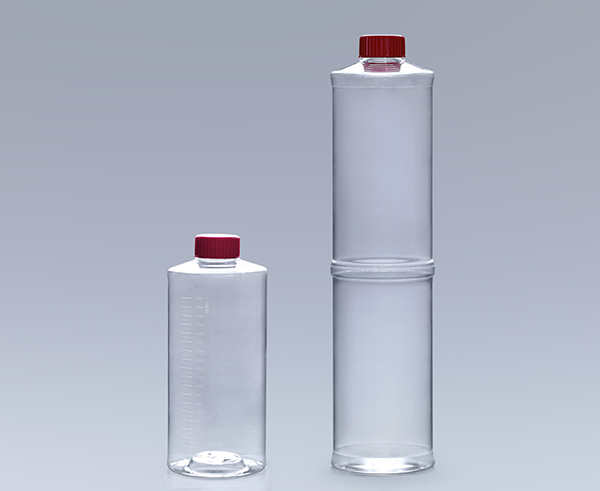
Cell Culture Roller Bottle
1. Recalculate the Total Cell Inoculum
The first parameter to review is the number of cells used for inoculation.
For adherent cell culture, scaling should be based primarily on culture area, not nominal bottle volume.
If an established 2L process uses a defined number of viable cells per cm², that value can be used as an initial reference when moving to a 5L roller bottle.
However, simply multiplying the original cell number according to bottle volume may result in an unsuitable seeding density.
Important factors include:
Available culture area
Viable cell concentration
Target seeding density
Attachment efficiency
Desired time to confluence
After scale-up, actual cell attachment and growth should still be verified rather than relying only on the calculated inoculum.
2. Re-Evaluate Medium Volume
A larger roller bottle generally requires a different working volume, but the correct amount of medium should not be determined by vessel capacity alone.
Medium volume influences:
Nutrient availability
Metabolite accumulation
Liquid movement
Cell-to-medium ratio
Gas exchange
Feeding frequency
Increasing the volume too much may alter the liquid-flow pattern as the bottle rotates. Using too little medium, on the other hand, may not provide sufficient nutrients for the increased cell population.
The working volume should therefore be optimized together with cell density, culture duration, and rotation conditions.
3. Check Rotation Conditions Again
The same roller speed used for a 2L bottle should not automatically be assumed to be optimal for a 5L bottle.
Changes in bottle diameter, liquid volume, and total weight can alter how the medium moves over the cell layer.
During process transfer, observe:
Whether cells distribute evenly
Whether the bottle rotates smoothly
Whether cells remain attached
Whether excessive bubbles or foam develop
Whether the monolayer forms uniformly
Initial attachment conditions may require particular attention because newly seeded cells are more sensitive to liquid movement.
The objective is not necessarily to change the rotation speed, but to confirm that the existing setting still produces stable culture conditions after scale-up.
4. Confirm Roller Apparatus Compatibility
A 5L roller bottle places different mechanical demands on the roller apparatus compared with a smaller vessel.
Before routine production, check whether the equipment can accommodate the larger format and whether each bottle maintains stable contact with the rollers.
Look for:
Bottle slipping
Irregular rotation
Sideways movement
Excessive vibration
Insufficient spacing
Changes in rotation after filling
For production runs involving multiple roller bottles, these small mechanical differences can become important because one unstable bottle may produce different culture conditions from the rest of the batch.
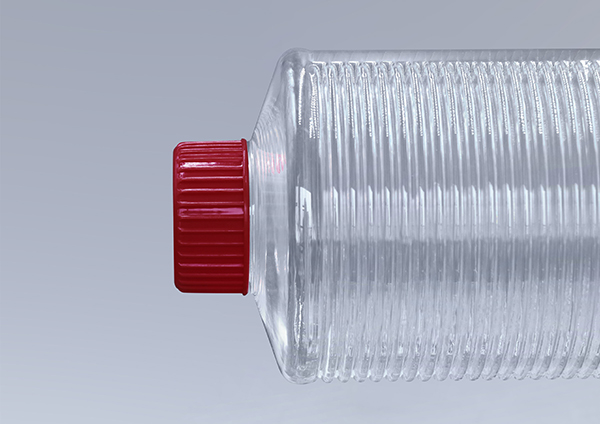
Expanded Surface Polystyrene Roller Bottle
5. Review Cell Attachment and Distribution
A larger growth surface means that cells must be distributed over a greater area.
Even when the calculated seeding density is correct, poor initial distribution may produce dense areas and sparse areas within the same bottle.
During the first scale-up runs, compare:
Initial cell attachment
Cell morphology
Monolayer uniformity
Time to target confluence
Cell detachment
Final viable cell recovery
Consistent preparation of the cell suspension and inoculation procedure becomes particularly important when multiple 5L roller bottles are filled from the same cell batch.
6. Reconsider Gas Exchange and Cap Operation
Scale-up can also change the relationship between cell number, medium volume, and available gas exchange.
As the cell population increases, oxygen demand and metabolic activity may also increase.
Users should therefore confirm that the existing cap configuration and incubator conditions remain suitable for the larger culture format.
Factors to review include:
Cap type
CO₂ requirements
Medium buffering system
Incubation time
Working volume
Cell density
Any changes should be evaluated under actual process conditions rather than based only on bottle size.
7. Review Medium Exchange and Handling
A larger vessel contains more liquid and is heavier during routine operation.
Steps that were easy with 2L roller bottles may require additional attention with 5L bottles, including:
Filling
Medium exchange
Washing
Virus inoculation
Sampling
Harvesting
Loading and unloading the roller apparatus
Handling procedures should minimize foaming, sudden liquid movement, and unnecessary disturbance of the cell monolayer.
For vaccine processes, aseptic operation should also remain consistent as the working volume increases.
8. Verify the Downstream Process
Reaching a similar cell confluence does not automatically mean that the complete process is equivalent.
When roller bottles are used for virus propagation or vaccine manufacturing, the scale-up study may also need to evaluate:
Cell condition before infection
Timing of virus inoculation
Cytopathic effect
Harvest timing
Virus production performance
Batch-to-batch consistency
The relevant acceptance criteria should come from the established production process.
Scale-Up Should Be Based on Culture Performance
Moving from 2L to 5L roller bottles is not simply a matter of using a larger container.
The most important parameters to re-evaluate are:
Seeding density
Total viable cell number
Medium volume
Rotation conditions
Cell attachment
Equipment compatibility
Gas exchange
Handling procedures
Downstream process performance
A useful approach is to keep as many established parameters as possible unchanged during the first comparison and adjust only those that are affected by the larger culture format.
Choosing Roller Bottles for Different Culture Scales
Different roller bottles allow manufacturers to select a culture format according to process scale, available equipment, and production requirements.
FDCELL provides roller bottles for adherent cell expansion, virus propagation, vaccine manufacturing, and other biopharmaceutical applications, including 2L and 5L formats for different culture scales.
When moving between bottle sizes, process parameters should be evaluated using the actual cell line, medium, roller apparatus, and production conditions. A successful scale-up is not defined simply by using a larger vessel, but by maintaining reproducible cell growth and process performance.










