For adherent cell culture, the T175 flask is commonly used in research, process development, seed train preparation, and small-scale cell expansion. However, when cell demand increases, using multiple T175 flasks can quickly become labor-intensive and space-consuming. At this stage, many laboratories and biopharmaceutical teams begin to evaluate a 10-layer cell factory as the next step in scale-up.
Scaling from a T175 flask to a 10-layer cell factory is not simply a matter of increasing surface area. Users need to consider seeding density, medium volume, cell distribution, gas exchange, handling method, harvest efficiency, and lot-to-lot consistency. A well-designed scale-up strategy helps maintain stable cell growth while improving output, labor efficiency, and incubator space utilization.

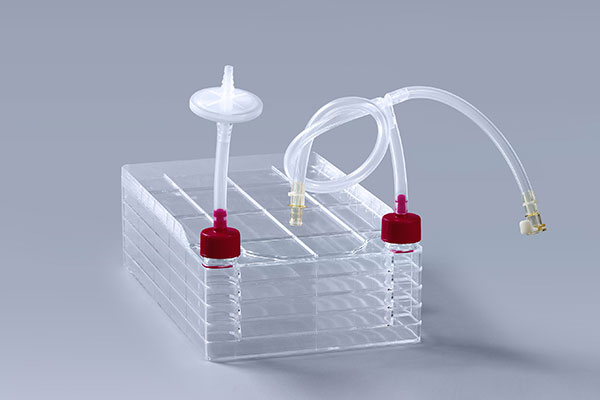
Multilayer Cell Factory
Why Move From T175 Flasks to a 10-Layer Cell Factory?
A T175 cell culture flask provides a practical format for routine adherent cell expansion. It is easy to observe, handle, seed, wash, and harvest. But when a process requires higher cell yield, the number of flasks needed can increase significantly.
Using many single-layer flasks may create several challenges:
More manual handling steps
Higher contamination risk during repeated operations
More incubator shelf space required
Longer time for medium exchange and harvesting
Greater batch-to-batch handling variation
More plastic waste and packaging volume
A 10-layer cell factory offers a larger growth surface in a compact multilayer format. It allows users to expand adherent cells with fewer vessels, fewer operations, and better space efficiency compared with running many individual T175 flasks.
Surface Area and Scale-Up Ratio
The first step is to calculate the surface area difference between the current T175 flask process and the target 10-layer cell factory process. A T175 flask provides about 175 cm² of growth area. A 10-layer cell factory provides a much larger total growth area, depending on the product design and nominal surface area per layer.
Instead of scaling only by vessel number, users should scale based on growth area. The same seeding density per cm² should be used as the starting point. For example, if a cell line performs well at a defined seeding density in a T175 flask, that density can be converted to the total surface area of the 10-layer cell factory.
This helps maintain comparable cell attachment, spreading, confluence rate, and final yield during the transition.
Seeding Density and Cell Suspension Preparation
Seeding density is one of the most important parameters when scaling from a T175 flask to a cell factory. Too few cells may lead to slow growth and uneven confluence. Too many cells may cause overcrowding, nutrient limitation, and early contact inhibition.
Before seeding a 10-layer cell factory, prepare a uniform cell suspension with good viability and minimal clumping. The suspension should be mixed gently but thoroughly to ensure that each layer receives a similar cell concentration. Cell counting accuracy is especially important because a small error in the seed train stage can be amplified during scale-up.
For sensitive cells such as Vero, MDCK, HEK293 adherent cells, MSCs, primary cells, or virus production-related cell lines, users should first perform a small comparison study before moving to routine production.
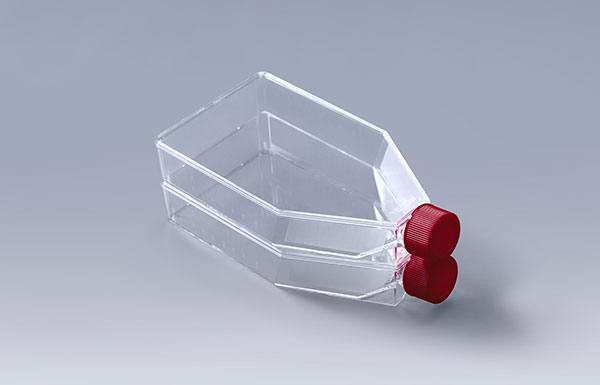
T175 TC-treated Cell Culture Flask
Medium Volume and Nutrient Supply
Medium volume should be scaled according to the growth surface, cell type, and process requirement. A 10-layer cell factory requires more medium than a T175 flask, but it may reduce the total number of separate vessels used in the workflow.
The goal is not only to increase total medium volume, but also to maintain an appropriate medium depth across all layers. Medium should support cell attachment, nutrient supply, pH stability, gas exchange, and waste dilution during the culture period.
When comparing T175 flasks and a 10-layer cell factory, users should evaluate:
Medium volume per cm²
Final cell yield per mL of medium
Cell viability at harvest
Glucose or nutrient consumption
Lactate or waste accumulation
Medium exchange frequency
Overall cost per batch
This helps determine whether the scale-up process is efficient, not just larger.
Even Cell Distribution Across Layers
One of the key differences between a T175 flask and a 10-layer cell factory is liquid distribution. In a single-layer flask, users can visually check whether the cell suspension covers the surface evenly. In a multilayer cell factory, uniform distribution across all layers is more critical and requires controlled handling.
After adding the cell suspension, the cell factory should be positioned and moved according to the recommended operating procedure. Sudden tilting, shaking, or incomplete distribution may cause uneven cell settlement. This can result in inconsistent confluence, lower final yield, or variation between layers.
During process development, users may evaluate distribution by observing representative areas, checking harvest yield consistency, and comparing cell morphology across batches.
Gas Exchange and Cap Configuration
Gas exchange is important for adherent cell culture. In T175 flasks, users often choose vented caps for routine CO₂ incubator culture. In a 10-layer cell factory, cap design, venting strategy, and closed-system connection options may influence process convenience and contamination control.
For routine laboratory use, vented configurations may be suitable. For bioprocess development, vaccine research, or larger-scale adherent cell expansion, closed or semi-closed operation can reduce contamination risk and improve process control.
When selecting a cell factory, users should consider whether the system supports medium filling, harvesting, tubing connection, and aseptic transfer requirements.
Harvesting From a 10-Layer Cell Factory
Harvesting is usually more complex in a 10-layer cell factory than in a T175 flask. Washing, dissociation reagent distribution, incubation time, tapping or gentle movement, and collection method should be optimized to improve cell recovery.
If the same trypsinization time used in a T175 flask is applied directly to a cell factory, detachment may be incomplete or uneven. Users should optimize reagent volume, contact time, temperature, and harvest procedure for the multilayer format.
Important harvest indicators include:
Detachment completeness
Final viable cell recovery
Cell viability after harvest
Clumping rate
Residual cells left on the surface
Batch-to-batch recovery consistency
A successful scale-up should maintain both high cell yield and acceptable cell quality.
Process Consistency and Lot-to-Lot Control
When moving from T175 flasks to a 10-layer cell factory, process consistency becomes more important. A larger vessel format means that any variation in surface treatment, material quality, sterilization, packaging, or handling can have a greater effect on the final batch.
Users should evaluate the cell culture flask stage and the cell factory stage together as part of the seed train. The surface performance of both products should support stable cell attachment, spreading, growth, and harvest.
Before routine use, it is recommended to test multiple lots under the same conditions. Record cell morphology, confluence, growth rate, viability, harvest yield, and any abnormal observations. This creates a traceable evaluation file for supplier qualification and internal process control.
When Is a 10-Layer Cell Factory the Right Choice?
A 10-layer cell factory is suitable when the T175 flask process is stable but no longer efficient enough for the required cell quantity. It is especially useful for adherent cell expansion in vaccine research, virus production studies, cell banking, process development, and early-stage biopharmaceutical workflows.
Users may consider moving to a 10-layer cell factory when:
The number of T175 flasks per batch becomes difficult to manage
Incubator space is limited
Manual handling time is too high
Batch consistency needs improvement
Higher cell yield is required
The process is preparing for further scale-up
For larger production needs, the process can later move from a 10-layer cell factory to 40-layer cell factories or other closed adherent culture systems.
Practical Recommendation
Scaling from a T175 flask to a 10-layer cell factory should be based on surface area, cell density, medium volume, handling method, and harvest performance. A stepwise comparison is better than a direct one-time replacement.
Start with the proven T175 flask process as the reference. Then calculate the scale-up ratio, prepare a consistent cell suspension, optimize medium volume, confirm cell distribution, and evaluate final yield and viability. Once the 10-layer cell factory process is stable, it can help reduce vessel count, improve incubator space utilization, and support more efficient adherent cell expansion.
FDCELL supplies sterile cell culture flasks and cell factories for adherent cell culture scale-up, including T25, T75, T175, T225 flasks and 10-layer or 40-layer cell factory systems. With controlled production, TC-treated surfaces, sterilization, and batch traceability, FDCELL supports laboratories, biopharmaceutical companies, vaccine manufacturers, and distributors requiring reliable cell culture consumables for research and bulk supply.
For customers planning to scale from T175 flasks to 10-layer cell factories, sample testing under actual culture conditions is recommended before large-volume purchasing.










