For many adherent cell culture workflows, the T75 flask offers a practical balance between culture area, medium consumption, handling, and cell yield. It is commonly used for routine cell maintenance, passaging, experimental preparation, and small-scale cell expansion.
However, T75 is not the best format for every stage of a culture process. Understanding where it works well—and where its limitations begin—can help laboratories choose a more efficient culture strategy.

cell culture flask
Why T75 Is Commonly Used for Routine Culture
With a nominal growth area of 75 cm², a T75 flask provides more culture surface than a T25 while remaining relatively easy to handle and observe.
For routine adherent cell maintenance, this can be useful because researchers can regularly check:
Cell morphology
Attachment and spreading
Confluence
Contamination
Changes in growth behavior
The format also allows cells to be harvested and passaged without introducing the handling complexity associated with much larger culture vessels.
Typical Uses of a T75 Flask
Routine Cell Maintenance
One of the most common applications is maintaining an established cell line through regular passages.
After cells reach the predetermined passage point, they can be harvested and reseeded into fresh T75 flasks at the required density. Keeping the vessel format consistent between passages can also simplify comparison of growth behavior over time.
Expansion After Cell Recovery
A T75 can serve as an intermediate step after cells have been successfully recovered in a smaller vessel.
For example, an adherent culture may progress from:
Cell Recovery → T25 → T75 → Larger Culture Format
Moving gradually through culture areas can be useful when the initial viable cell number is limited.
Preparing Cells for Experiments
T75 flasks can also be used to generate cells for downstream experiments, such as assay preparation, cell-based studies, or other laboratory procedures.
The appropriate number of flasks depends on the required viable cell yield rather than flask size alone.
Small-Scale Process Development
When evaluating parameters such as passage timing, inoculation density, medium conditions, or harvesting procedures, T75 flasks provide a manageable format for running multiple cultures in parallel.
This can be useful before transferring an established process to T175, T225, or multilayer vessels.
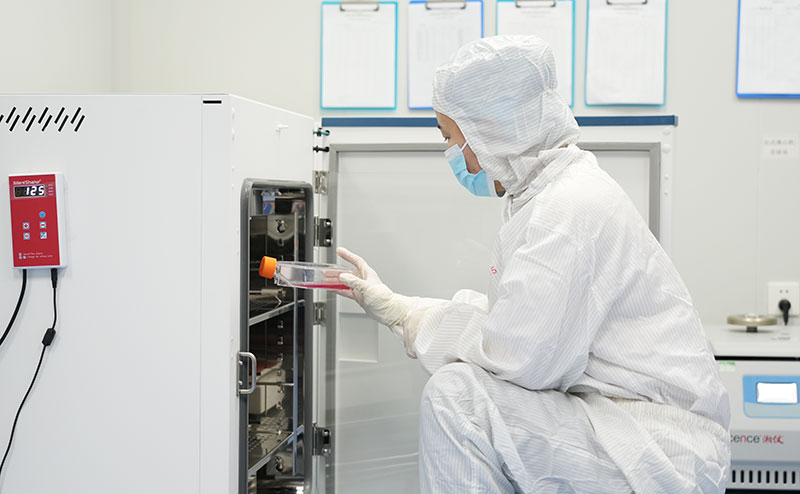
quality control and certificates
Important Factors During Routine Maintenance
Using the same flask size does not automatically guarantee consistent cell growth. Several culture variables should remain controlled between passages.
Seeding density is particularly important. Large differences in starting cell density may change the time required to reach the desired confluence.
Medium volume should also be appropriate for the culture process and cell line. Both insufficient and unnecessarily high working volumes can affect routine operation and resource use.
In addition, cells should be distributed evenly across the growth surface after inoculation. Localized clustering can result in uneven confluence even when the total inoculated cell number is correct.
When Does T75 Become Limiting?
The advantages of T75 flasks begin to decrease when substantially larger cell quantities are required.
If a process requires many T75 flasks at the same time, operators may face:
More repetitive filling and harvesting
Increased incubator space requirements
More individual vessels to label and track
Greater manual handling
Longer processing time
At this stage, increasing the number of T75 flasks may not be the most efficient way to obtain additional culture area.
A T175 or T225 flask can provide more growth surface per vessel, while multilayer systems may be considered when the required adherent culture area increases further.
T75 vs. Larger Flask Formats
Choosing between T75, T175, and T225 should depend on the purpose of the culture.
For routine maintenance, observation, and moderate cell requirements, T75 often remains convenient. For larger inoculum preparation or repeated cell expansion, larger formats may reduce the number of vessels that need to be handled.
The decision should therefore consider not only nominal growth area, but also:
Required cell quantity
Number of passages
Available incubator space
Harvesting workload
Process consistency
Next scale-up step
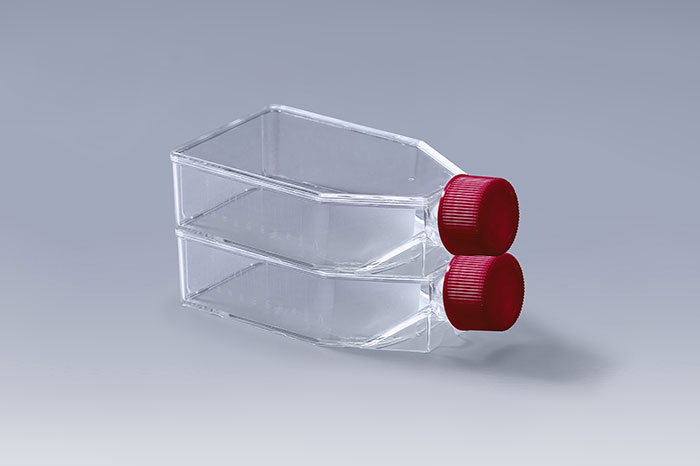
T75 TC-treated Cell Culture Flask
A Practical Role in the Cell Culture Workflow
The T75 flask is particularly useful as a routine maintenance and intermediate expansion format. It provides enough growth area for many laboratory workflows while remaining convenient for observation, passaging, and experimental preparation.
Its limitation is mainly one of scale. Once cell demand increases to the point that many individual T75 flasks are required, moving to a larger culture format may provide a more practical workflow.
For laboratories using different vessel sizes throughout cell expansion, FDCELL offers a T25–T225 T-flask range with TC-treated and non-treated options and different cap configurations for a variety of cell culture workflows.










