Seed train development connects a small starting cell population with the larger cell quantity required for downstream culture or production. Before moving into multilayer vessels or other larger-scale systems, laboratories often use T-flasks as flexible expansion steps.
T25, T75, T175, and T225 formats allow cell numbers to increase progressively while key culture parameters can still be closely observed and adjusted. For adherent cells, this makes cell culture flasks particularly useful during early and intermediate stages of seed train development.

cell culture flask
What Is a Seed Train?
A seed train is a sequence of culture expansion steps used to increase cell numbers while maintaining suitable cell condition.
For adherent cell culture, a simplified progression may look like:
Cell Recovery → T25 → T75 → T175/T225 → Multilayer Culture → Larger-Scale Process
The exact sequence varies according to cell type, required cell quantity, available equipment, and the final production system.
The objective is not simply to reach a larger vessel. Each expansion step should provide enough healthy cells to inoculate the next stage at an appropriate density.
Why T-Flasks Work Well in Early Seed Train Stages
Early in a seed train, cell numbers may be limited and culture performance needs to be observed carefully.
T-flasks provide several practical advantages:
Multiple growth areas for progressive expansion
Easy microscopic observation
Flexible working volumes
Separate vessels for process comparison
Straightforward cell harvesting
Convenient transition between small and larger culture areas
A T25 flask may be suitable during initial recovery, while T75, T175, and T225 formats provide progressively larger growth surfaces as the cell population increases.
This allows laboratories to expand cells without moving into a much larger culture system too early.
Maintain Seeding Density Between Expansion Steps
One of the most important considerations in seed train development is the inoculation density at each stage.
Simply transferring cells from one flask into a larger vessel without considering growth area can result in a very different starting density.
For example, moving from a T75 to a T225 flask increases the nominal growth area threefold. The viable cell number used for inoculation should therefore be considered relative to the available culture surface.
Consistent seeding density can help reduce variation in:
Attachment
Cell spreading
Growth rate
Time to target confluence
Final cell yield
This becomes increasingly important when the seed train is intended to support a reproducible production process.
Define the Right Expansion Point
Cells do not always need to reach maximum confluence before moving to the next seed train stage.
Waiting too long may lead to overcrowding, increased nutrient demand, and changes in cell condition. Expanding too early, however, may provide too few cells for efficient inoculation of the next vessel.
A suitable expansion point should consider:
Cell confluence
Morphology
Viability
Growth rate
Required inoculation density for the next stage
Establishing a defined passage window can make the seed train more predictable from batch to batch.
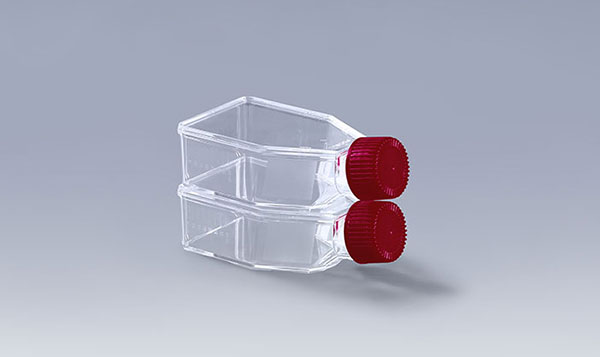
T25 TC-treated Cell Culture Flask
Keep Medium and Harvest Conditions Consistent
As flask size increases, medium volume and harvesting requirements also change.
A seed train should therefore consider not only cell numbers but also:
Medium volume relative to growth area
Feeding or medium exchange frequency
Washing volume
Dissociation conditions
Harvest efficiency
Viable cell recovery
These parameters should be evaluated before moving into larger culture formats.
If harvesting from a T225 flask produces inconsistent recovery, for example, transferring the same process directly into a multilayer system may increase variability rather than solve it.
When Should the Seed Train Move Beyond T-Flasks?
T-flasks are useful because they are flexible, but they become increasingly labor-intensive as the required growth area increases.
A transition to a multilayer culture system may be appropriate when:
Many T175 or T225 flasks are required per batch
Manual filling and harvesting become inefficient
Incubator space becomes limiting
Operator handling increases substantially
A larger inoculum is required for the next process stage
At this point, multilayer cell culture systems can provide greater growth area while reducing the number of individual vessels that need to be handled.
The transition is generally easier when seeding density, medium requirements, growth characteristics, and harvesting conditions have already been established during the T-flask stages.
Traceability Across the Seed Train
For development and quality-sensitive applications, each expansion stage should be documented.
Useful records may include:
Cell passage number
Flask size
Seeding density
Culture date
Medium and working volume
Harvest time
Viable cell yield
Consumable lot number
These records help identify where variability may have entered the process and make comparisons between seed train runs more meaningful.
Building a More Predictable Seed Train
A successful seed train should increase cell numbers without introducing unnecessary changes between expansion stages.
T25, T75, T175, and T225 flasks provide a practical progression for early and intermediate adherent cell expansion. By controlling inoculation density, passage timing, medium conditions, and harvesting, laboratories can establish a stronger foundation before moving to larger culture formats.
FDCELL offers a T25–T225 cell culture flask range with TC-treated and non-treated surfaces and different cap configurations for laboratory, process development, and cell expansion applications.
A well-designed seed train helps ensure that scale-up begins with a consistent and well-characterized cell population rather than simply a larger number of cells.










