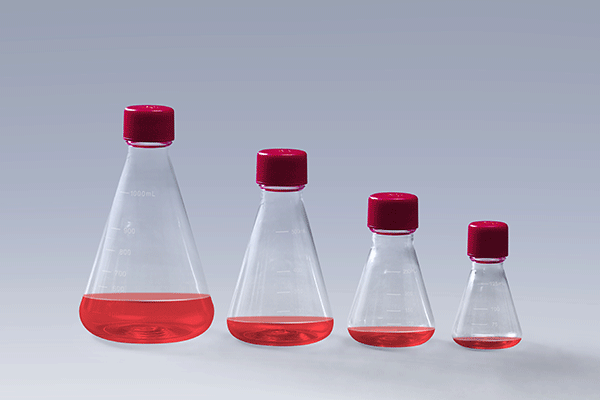
When cell growth changes between shake flask experiments, the first questions usually focus on the cells, medium, inoculation density, or incubator conditions. But when these parameters remain unchanged, another source of variability is worth checking: the Erlenmeyer Shake Flask itself.
For suspension culture, a shake flask is more than a container. Flask geometry, cap ventilation, working volume, material consistency, and handling conditions can all influence the culture environment. Understanding these variables is particularly important when comparing different flask batches or evaluating a new supplier.
Is the Shake Flask Really Causing the Difference?
Not every difference in cell growth comes from the flask.
Before investigating consumables, confirm that major process parameters are comparable between experiments, including:
Cell passage and starting viability
Inoculation density
Medium and supplement lots
Working volume
Shaking speed and shaker orbit
Temperature and CO₂ conditions
Culture duration and sampling schedule
If these variables are controlled but growth differences continue to appear after changing flask lots, the shake flask should be included in the investigation.
1. Small Differences in Flask Geometry Can Affect Mixing
The conical geometry of an Erlenmeyer Flask determines how liquid moves during orbital shaking. Diameter, bottom profile, neck dimensions, and overall shape influence wave formation and the gas-liquid interface.
Even when two flasks have the same nominal capacity, differences in geometry can produce different mixing patterns.
For suspension cells, this may affect cell distribution and nutrient availability. For oxygen-demanding cultures, it may also influence oxygen transfer.
This is one reason why dimensional consistency matters when an Erlenmeyer Shake Flask is used in a standardized process.
2. Vent Cap Performance Can Change the Culture Environment
For aerobic shake flask culture, the cap is part of the gas exchange system.
A vent cap typically uses a hydrophobic membrane to permit gas exchange while maintaining a microbial barrier. If membrane properties, effective venting area, cap fit, or assembly consistency differ between batches, gas exchange conditions may also change.
The effect may not be obvious at low cell density. As the culture grows and oxygen demand increases, however, differences in ventilation can become more significant.
When troubleshooting unexplained growth variation, the flask and cap should therefore be evaluated as one system.
3. Working Volume Magnifies Other Differences
Working volume has a major influence on mixing and oxygen transfer in an Erlenmeyer Shake Flask.
A process operating close to its oxygen-transfer limit may be more sensitive to small differences in flask geometry or cap ventilation than a process with a larger operating margin.
For this reason, actual fill volume should be kept consistent when comparing batches. Nominal flask capacity alone is not enough to establish equivalent culture conditions.
If a 500 mL flask is normally operated at 150 mL, for example, comparative testing should use the same working volume, shaker, orbit, speed, and incubation conditions.
4. Material and Manufacturing Consistency Matter
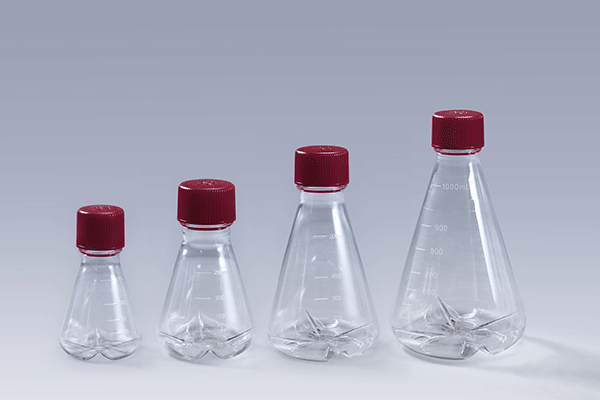
Disposable shake flasks are commonly manufactured from materials such as PETG or PC. For cell culture applications, the suitability of the raw material is important, but so is consistency in the finished product.
Manufacturing variations can potentially affect:
Flask dimensions
Wall thickness
Neck and closure fit
Surface condition
Graduation accuracy
Mechanical stability during shaking
The importance of each characteristic depends on the application. Rather than assuming that every dimensional difference will affect cell growth, manufacturers and users should identify which attributes are critical to their specific culture process.
5. Sterilization, Packaging and Storage Should Not Be Overlooked
For a single-use Erlenmeyer Shake Flask, the product continues to be affected by its handling after molding.
Sterilization conditions, packaging integrity, transportation, and storage can all be relevant when investigating an unexpected result. Damaged packaging, improper storage, or compromised closure integrity should be ruled out before the flask enters a culture process.
For regulated or scale-up applications, lot identification and traceability also make it easier to determine whether an unexpected result is isolated or associated with a particular batch.
User Guide for Erlenmeyer Shake Flask
How Should Different Shake Flask Batches Be Compared?
Visual inspection alone cannot demonstrate that two lots will perform identically in culture.
For critical applications, a more useful approach is to run a controlled side-by-side comparison. Keep the cell source, medium, inoculation density, working volume, shaker settings, and sampling points consistent, and compare relevant culture outcomes.
Depending on the process, these may include:
Viable cell density
Cell viability
Growth rate
Culture duration
Metabolite profiles
Product titer or another process-specific performance indicator
The objective is not simply to prove that two flasks look the same, but to determine whether they provide comparable performance under the intended conditions of use.
Batch Consistency Becomes More Important During Scale-Up
Minor variability may be manageable during exploratory research. The situation changes when an Erlenmeyer Flask becomes part of an established seed train or upstream process.
At this stage, unexpected changes can lead to repeated experiments, additional investigations, delayed scale-up, or supplier requalification work.
For procurement, QA, and process development teams, evaluating a shake flask supplier therefore goes beyond unit price. Relevant considerations may include manufacturing controls, lot traceability, quality documentation, change management, supply continuity, and demonstrated performance in the user's process.
This is especially important when qualifying a second source or replacing an existing consumable.
Conclusion
When cell growth varies between shake flask batches, the cause should be investigated systematically rather than attributed immediately to either the cells or the consumable.
Cell condition, medium, working volume, shaking parameters, and environmental conditions should be checked first. If these remain controlled, Erlenmeyer Shake Flask geometry, vent cap performance, manufacturing consistency, sterilization, and packaging become relevant factors to evaluate.
For routine research, these details help improve reproducibility. For biopharmaceutical processes, consistent Erlenmeyer Flask performance can also support smoother scale-up, supplier qualification, and long-term process control.










