When scaling adherent cell culture from a smaller flask to a larger format, it is tempting to estimate cell yield directly from the increase in growth surface area.
For example, if the available culture area increases threefold, should the final cell yield also increase threefold?
Surface area provides a useful starting point for scale-up calculations, but actual cell yield is influenced by much more than vessel size. Seeding density, cell attachment, nutrient availability, culture conditions, confluence at harvest, and cell recovery can all affect the final result.
Understanding these variables is important when designing a reproducible adherent cell expansion process.

cell culture flask
Surface Area Defines Capacity, Not Guaranteed Yield
For adherent cells, available growth surface places an important physical limit on culture capacity. A larger flask provides more area for cell attachment and proliferation.
However, nominal growth area should not be treated as a direct prediction of harvested cell number.
Two cultures with the same cell density per square centimeter at inoculation can still produce different final yields if their attachment efficiency, growth kinetics, culture environment, or harvest efficiency differ.
Therefore, surface area is better considered as one scale-up parameter rather than a stand-alone predictor of productivity.
Seeding Density Must Be Considered During Scale-Up
One of the first variables to examine is inoculation density.
If a smaller flask is seeded at an established cell density but the larger flask receives insufficient inoculum relative to its growth area, the cells begin the culture at a lower density.
Depending on the cell type and process, this may influence:
Cell attachment and distribution
Lag phase after inoculation
Growth kinetics
Time to target confluence
Final harvest timing
For this reason, scale-up calculations should consider viable cells per unit growth area, not simply the total number of cells transferred into each flask.
Attachment Efficiency Can Change the Effective Starting Population
The number of cells introduced into a flask is not necessarily the same as the number of cells that successfully attach and continue proliferating.
Attachment can be influenced by the cell type, passage condition, medium, handling procedure, surface characteristics, and distribution of the inoculum across the growth surface.
This is one reason why the performance of cell culture flasks should be evaluated not only by their stated growth area but also by their ability to support consistent adherent cell culture under the intended process conditions.
A larger nominal surface provides little benefit if a portion of that area is not used effectively by the cells.
Cell Distribution Becomes Increasingly Important
Uniform distribution matters when increasing culture area.
If cells accumulate disproportionately in certain regions after seeding, local areas may reach high density earlier while other areas remain sparsely populated. The vessel may therefore have a large total growth area without that area being used uniformly.
This can affect both apparent confluence and the final number of cells available for harvest.
A standardized seeding and distribution procedure is therefore important when comparing different flask sizes or establishing a scale-up process.
Medium Conditions Do Not Scale Only With Surface Area
Increasing growth area usually requires an adjustment in culture medium volume, but the relationship between surface area, cell number, and medium requirement is not always perfectly linear.
As cell biomass increases, nutrient consumption and metabolite accumulation also change.
Important factors include:
Medium volume per culture area
Cell-specific metabolic demand
Culture duration
Frequency of medium exchange
Glucose and other nutrient availability
Accumulation of metabolic by-products
If a larger culture reaches a higher total cell population but the medium strategy is not adjusted appropriately, growth may become limited before the available surface is fully utilized.
Confluence at Harvest Can Distort Yield Comparisons
Another common problem is comparing flasks harvested at different biological endpoints.
For example, a smaller flask harvested near the intended confluence may be compared with a larger flask harvested according to the same number of culture days rather than the same biological condition.
These cultures are not necessarily equivalent.
When comparing cell yield across flask formats, it is more useful to record both:
culture time and cell condition at harvest.
This helps determine whether a yield difference comes from vessel scale or simply from different growth stages.
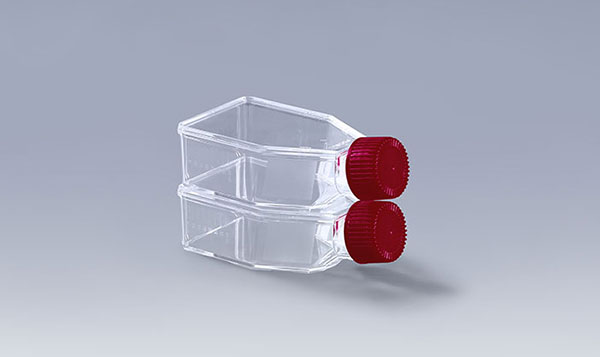
T25 TC-treated Cell Culture Flask
Harvest Recovery Is Part of the Yield Equation
Final cell yield is usually measured after cell detachment and collection. This means harvest efficiency also contributes to the measured result.
Cells may remain on the culture surface because of incomplete washing, insufficient exposure to dissociation reagent, uneven reagent distribution, or incomplete mechanical assistance where appropriate.
Cell losses can also occur during transfer, centrifugation, resuspension, and counting.
A useful way to think about the process is:
Available Growth Area → Attached Cell Population → Expanded Cell Population → Recovered Viable Cells
Each stage can introduce variation.
Therefore, a larger flask may support a larger cell population without producing an exactly proportional increase in the number of viable cells finally recovered.
Evaluate Yield per Unit Area
When comparing flask formats, total cell yield alone can be misleading.
A useful additional metric is:
Viable Cell Yield per cm² = Total Recovered Viable Cells ÷ Growth Area
This allows process developers to determine whether increasing vessel size is maintaining comparable biological performance.
If total yield increases while yield per cm² decreases substantially, the process may require further investigation.
Possible causes include inoculation density, attachment, medium conditions, uneven distribution, harvest timing, or recovery efficiency.
Use Scale-Up Data to Build the Expansion Strategy
Instead of assuming a fixed multiplication factor between flask sizes, process developers can generate scale-up data under controlled conditions.
Where appropriate, comparisons can keep key variables consistent, such as:
Cell source and passage
Seeding density per cm²
Medium formulation
Medium volume relative to culture area
Incubation conditions
Harvest criteria
Cell counting method
Cell morphology, attachment, culture time, confluence, viability, total yield, and yield per cm² can then be compared.
These data provide a stronger basis for designing an adherent cell expansion strategy and deciding when to move from T-flasks to larger culture formats.
From Flask Surface Area to a Reproducible Expansion Process
Growth surface area remains a fundamental parameter in adherent cell culture, but it represents available culture capacity rather than guaranteed cell output.
A successful scale-up strategy should consider the entire biological process surrounding that surface: inoculation, attachment, distribution, nutrient availability, proliferation, harvest timing, and cell recovery.
For this reason, moving from a smaller flask to a larger flask—or eventually to a multilayer culture system—should be supported by process data rather than surface-area ratios alone.
The objective is not simply to provide more square centimeters for cells to grow. It is to ensure that the additional surface can be used consistently and converted into reproducible viable cell yield.










