European Pharmacopeia (Ph. Eur.) - Harmonised chapter uniformity of dosage units
Background. H+V June 2012
Between 2004 and 2008, various questions and answers have been published on this websiteto clarify how the harmonised European Pharmacopoeia (Ph. Eur.) chapter on uniformity ofdosage units (2.9.40) and the general chapters on uniformity of mass of single-dosepreparations (2.9.5) and uniformity of content of single-dose preparations (2.9.6) should beapplied in the European Union (EU), also in view of the compliance objection made by theUnited States Food and Drug Administration to the USP on the 2% relative-standard-deviationclause in general chapter 2.9.40. This matter has been recently reviewed by EU regulators andthe resulting agreed position is presented in the following questions and answers, whichreplace the previous questions and answers 1 and 4 published on the same subject in 2004 and2006,which have now been deleted from the website.
1. How should industry demonstrate compliance with the EuropeanPharmacopoeia with regard to uniformity of dosage units? H+V June 2012
Medicinal products marketed in the European Union need to be in compliance with the relevant requirements in the European Pharmacopoeia (Ph. Eur.).
From a pharmaceutical quality point of view, the approach taken in the harmonised general chapter on uniformity of dosage units (2.9.40) is considered equivalent to what was previously required in the Ph. Eur. through the general chapters on uniformity of mass of single-dose preparations (2.9.5) and uniformity of content of single-dose preparations (2.9.6). These general chapters, 2.9.5 and 2.9.6, are still included in the current version of the Ph. Eur.
Taking this into account, the decision on what approach to take is left to the applicant. Application of either the Ph. Eur. harmonised general chapter on uniformity of dosage units (2.9.40) or the Ph. Eur. general chapters on uniformity of mass of single-dose preparations (2.9.5) and uniformity of content of single-dose preparations (2.9.6) are both considered acceptable options to demonstrate compliance with the Ph. Eur. with regard to uniformity of dosage units.
Please note that this advice supersedes the previous questions and answers 1 and 4 published on the same subject in 2004 and 2006. The remaining previously published questions and answers on the use of the general chapter 2.9.40 (former questions and answers 2, 3, 5 and 6) are still valid and remain published as questions and answers 2 to 5.
2. How should the new text be interpreted, in particular in relation to testing frequency (routine test / skip test / test on validation batches only)? H+V March 2006
Where a dosage form monograph in the European Pharmacopoeia refers to this general chapter, the product should comply. This is normally verified by routine testing unless otherwise justified and authorised.
3. How can the text be interpreted in light of the compliance objection made by the Food and Drug Administration to the United States Pharmacopeia on the 2% relative standard deviation clause? H+V March 2006
The harmonised text is included in the European Pharmacopoeia and the 2% clause will thus be valid in the European Union. This will not be dependent on the final outcome of the discussion between the Food and Drug Administration and the United States Pharmacopeia.
4. When can the requirements in the harmonised European Pharmacopoiea general chapter on uniformity of dosage units (2.9.40) for mass variation be applied with reference to a RSD of not more than 2%? H+V 2008
When can the requirements in the harmonised European Pharmacopoiea general chapter on uniformity of dosage units (2.9.40) for mass variation, rather than content uniformity, be applied with reference to a relative standard deviation (RSD) of not more than 2%? Is it sufficient to determine the RSD on for example 3 validation batches? H+V July 2008
It is the opinion of the Quality Working Party that the requirement in the harmonised chapter 2.9.40 regarding the 2% relative-standard-deviation clause represents minimum requirements. The use of this clause should be based on sufficient experience. Normally, results from 3 validation batches are not sufficient. It is rather to be used post-approval when more extensive production experience is gained.
5. What is meant by single component and multiple component in the harmonised chapter 2.9.40? H+V July 2008
'Single component' means one active substance with no excipient. 'Multiple component' could mean 'at least 2 active substances' or 'at least 1 active substance and at least one excipient'; both cases are valid.
European Pharmacopeia (Ph. Eur.) - Phasing out Rabbit Pyrogen Test
Directive 2010/63/EU establishes measures for the protection of animals used for scientific and educational purposes, with the final aim of replacing all animal research with non-animal methods. To that end, the Directive lays down principles of replacement, reduction and refinement (3Rs). When choosing methods, these principles should be implemented through a hierarchy, with the ultimate goal of replacing animal testing by alternative methods. The principle of replacement ensures that a procedure using live animals is not carried out, if another method or testing strategy is recognised under the legislation of the Union that does not entail the use of live animals.
EMA supports the implementation of this Directive and the 3Rs principles in the EU, by, among other initiatives, helping marketing authorisation holders to comply with new or revised measures. The 3Rs Working Party acts as a focal hub for EMA 3Rs activities and has recently published a Reflection Paper on the current regulatory testing requirements for human medicinal products and opportunities for implementation of the 3Rs.
In this context, EMA is publishing guidance for phasing out the Rabbit Pyrogen Test, following the revision of the European Pharmacopoeia. This revision includes the introduction of a new general chapter, 5.1.13 Pyrogenicity and the removal of references to the Rabbit Pyrogen Test from 57 existing monographs. The new and revised texts will be published in Supplement 11.8 of the Ph. Eur., with an implementation date of 1 July 2025. As a result, the use of the Rabbit Pyrogen Test will no longer be required in any text of the European Pharmacopoeia and it will be the responsibility of medicine developers to select a suitable in vitro test to control the pyrogenicity of their product, based on a risk assessment as described in the new general chapter 5.1.13.
Applicants/Marketing Authorisation Holders are reminded that EU law makes specific reference to the mandatory character of the European Pharmacopoeia’s monographs in Directive 2001/83/EC on medicines for human use. Therefore, to comply with these changes, Applicants/Marketing Authorisation Holders should remove the Rabbit Pyrogen Test from their Marketing Authorisation dossiers and assess the need for a method replacement.
1. What actions need to be taken to remove the Rabbit Pyrogen Test fromMarketing Authorisation dossiers? H May 2025
Following a revision of the European Pharmacopoeia (Ph. Eur.), the Rabbit Pyrogen Test is being deleted from Ph.Eur. texts. The revised texts omitting references to chapter 2.6.8 Pyrogens are published in Supplement 11.8 of the Ph. Eur., with an implementation date of 1 July 2025. Chapter 2.6.8 will be permanently deleted from the Ph. Eur. in January 2026.
Applicants/Marketing Authorisation Holders (MAHs) are reminded that EU law makes specific reference to the mandatory character of the Ph. Eur. monographs in Directive 2001/83/EC.
Therefore, to comply with the changes to the Ph. Eur., MAHs should remove the Rabbit Pyrogen Test from their Marketing Authorisation dossiers and assess the need for a method replacement.
In accordance with the new general chapter 5.1.13 Pyrogenicity, Applicants/MAHs should perform a risk analysis and assess the potential presence of pyrogens. It is the Applicant’s/MAH’s responsibility to decide on a testing strategy and limits.
In case the risk assessment shows that a new method needs to be added, the Applicant/MAH should consider that the general chapter 5.1.13 Pyrogenicity makes reference to 2.6.14. Bacterial endotoxins, 2.6.32. Test for bacterial endotoxins using recombinant factor C, and 2.6.30. Monocyte-activation test.
However, if the risk assessment shows that a suitable method is already being applied in the existing controls of the product, the addition of a replacement method may not be required.
An update of the Marketing Authorisation dossier to remove or replace the Rabbit Pyrogen Test will always require the submission of a variation for assessment. The type of variation to be submitted will depend on whether or not a replacement method is proposed and on the type of replacement method.
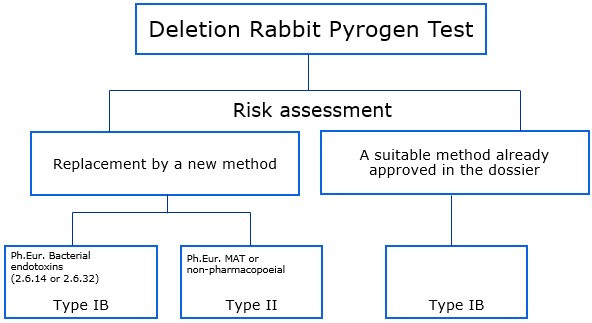
In case the risk assessment concludes that a suitable method is already being approved in the dossier and allows appropriate control in the absence of the Rabbit Pyrogen Test, a type IB variation should be submitted for the removal of the Rabbit Pyrogen Test. The risk assessment should be included in the submission.
In case a replacement method is proposed, the type of variation would depend on the type of method. In case of a pharmacopoeial bacterial endotoxins method (2.6.14 or 2.6.32), a type IB variation should be submitted. In case of the pharmacopoeial monocyte activation test (2.6.30 MAT) or a non-pharmacopoeial in vitro method, a type II variation should be submitted.
The different scenarios are summarised in the decision tree below.
With regard to the specific scope of the variation, this will depend on the situation and on where the Rabbit Pyrogen Test is applied (this may include the finished product, active substance, starting/raw materials, reagents, intermediates or excipients). Note that “z” scopes may be used in order to facilitate the submission, clearly identifying in the precise scope if it relates a replacement by a new method or a deletion without replacement (reliance on a suitable approved method).
Some examples are provided below, but the list is not exhaustive.
B.I.b.1.z - Change in the specification parameters and/or limits of an active substance, starting material / intermediate / reagent used in the manufacturing process of the active substance – Other changes
B.II.d.1.z - Change in the specification parameters and/or limits of the finished product – Other changes
B.II.c.1.z - Change in the specification parameters and/or limits of an excipient – Other changes
This guidance has been agreed by the Biological Working Party (BWP) and the Quality Working Party (QWP) and applies to human centrally and nationally authorised products (CAPs and NAPs). In case of questions, the MAH should contact the responsible Authority (EMA for CAPs; National Competent Authorities for NAPs).
Impurities - Calculation of thresholds for impurities
Impurities - Calculation of thresholds for impurities
1. What is the basis for the calculation of thresholds to set limits for impurities in the finished product specification? H June 2024
Mono-component products
For medicinal products containing only one active substance, the calculated thresholds should be based on the highest maximum daily dose of the respective active substance in authorised medicinal products and the limits in the specification set accordingly. The threshold for impurities should be the same for all strengths. The applicant is responsible to consider the maximum daily dose (MDD) that is approved for a given active substance. Since the MDD may differ between pharmaceutical forms, the MDD of the active substance in authorised medicinal products having the same pharmaceutical form should be considered.
Fixed Dose Combination products (FDC)
For medicinal products containing more than one active substance, the calculated threshold should be based on the maximum daily dose (MDD) described in the SPC of the FDC(s) under evaluation. The FDC(s) are indeed developed in a specific ratio of active substances composing the medicinal product and therefore considering the MDD of an active substance in mono-component medicinal products would not be appropriate.
If an unidentified impurity cannot be assigned to one of the active substances in the FDC it has to be compared to the signals of all active substances in order to verify whether the respective ICH identification threshold is exceeded or not. If exceeded, the impurity should be identified and assigned to the signal of the respective active substance. If not exceeded, the specification limit should be set with reference to the active substance that would ensure the lowest amount/exposure to the patient.
2. Is it required to consider the content of elemental impurities in a veterinary medicinal product? V October 2017
Yes. In accordance with Annex I of Directive 2001/82/EC, all relevant European Pharmacopoeia (Ph. Eur.) monographs, including general monographs and general chapters, are applicable with respect to the quality (pharmaceutical) part of dossiers for non-immunological veterinary medicinal products.
The Ph. Eur. General Monograph Substances for Pharmaceutical Use* requires that elemental impurities are considered in a risk assessment and the Ph. Eur. General Monograph Pharmaceutical Preparations* requires elemental impurities to be controlled based on a risk assessment for products outside the scope of Ph. Eur. Chapter 5.20 on Elemental Impurities*.
Whilst specific guidance for veterinary medicinal products is currently not available with respect to application of these principles to elemental impurities, the principles elaborated in the ICH guideline Q3D can be adapted and applied to veterinary medicinal products, or other justified approaches used.
* Note: Published in revised form in Ph. Eur. 9.3 in July 2017
3. When a limit for a nitrosamine is included on a CEP, how should it be managed for veterinary medicinal products? (V)
This Q & A is specific to nitrosamine impurities in veterinary medicinal products only and must not be extrapolated to other situations.
Some CEPs include limits for nitrosamine impurities. It is acknowledged that the requirements for risk evaluation of nitrosamines formation in the Ph. Eur. General Monographs 2034 Substances for pharmaceutical use and 2619 Pharmaceutical preparations are specific to human medicinal products. Nevertheless, the presence of nitrosamines in a veterinary medicinal product (VMP) should be controlled. Taking into consideration the detailed substance specific acceptable intake information available in Appendix 1 to the Q&A for human medicines (EMA/409815/2020).
Therefore, when a limit for a nitrosamine impurity is included on a CEP, it must be controlled in the active substance used in the VMP1. When the CEP is being added to an existing MAA or updated following a revision of the CEP, this may be done by way of VRA or VNRA, depending on an adjusted limit for the nitrosamine for the specific veterinary medicinal product.
1This applies even in the rare situations where a statement such as ‘Applicable only for human products. Not applicable for veterinary medicinal products.’ is included on the CEP annexes.
Calculation of adjusted nitrosamine limit for veterinary medicinal product:
Using the acceptable intake (AI) for human medicines, an adjustment for veterinary medicines should be made as follows:
AIvet (ng/kg bw/day) = AIhuman (ng/pers/day) /50 (kg)
The acceptable limit for the nitrosamine is then calculated as follows:
Limit (ppm) = AIvet (ng/kg) /max daily dose of active substance (mg/kg bw)
If the limit for the veterinary medicinal product, as calculated above, is equal to or above the limit specified on the CEP, the nitrosamine limit specified on it, may be included in the MAA via a VNRA. However, if the limit for the veterinary medicinal product, as calculated above, is below the limit specified on the CEP, the CEP must be included via a VRA-R F.III.1.a.z and the safety of the limit will be evaluated within the assessment of that VRA. For both VNRAs and VRAs, the calculations made by the MAH to decide whether a VRA or VRNA applies should be included in the variation documentation submitted to the Competent Authority.
In the event that an MAH wants to justify a higher limit than that specified on the CEP for the nitrosamine(s), this can only be reviewed in the context of a VRA application. In the absence of a limit for the nitrosamine in Appendix 1 to the Q&A for human medicines (EMA/409815/2020), or in cases where more than one nitrosamine is included on the CEP, a VRA submission is required.
When the CEP is included in an initial MAA this will be dealt with during the initial assessment using the same principles described above for variation applications.
For example:
CEP states a limit for nitrosamine of 1 ppm:
Situation 1
The calculated limit for the VMP is below this e.g. 0.5 ppm. In this case, the CEP limit is above the limit for the VMP and therefore assessment is needed for the VMP application and submission of the CEP as a VRA is needed;
Situation 2
The calculated limit for the VMP is the same as or above this e.g. 1 ppm or 2 ppm. In this case the CEP limit is equal to or stricter than needed for the VMP and no assessment is needed. The CEP limit can be applied, and submission of the CEP as a VNRA is acceptable.
Source: EMA