In the microscopic world of life science research, Square Media Bottles PET PETG are not just simple storage containers but precision tools tailored to meet diverse experimental demands. From cell culture to molecular detection, different experimental scenarios impose unique requirements on the material, size, and functionality of these bottles—details that often determine the success or failure of an experiment.
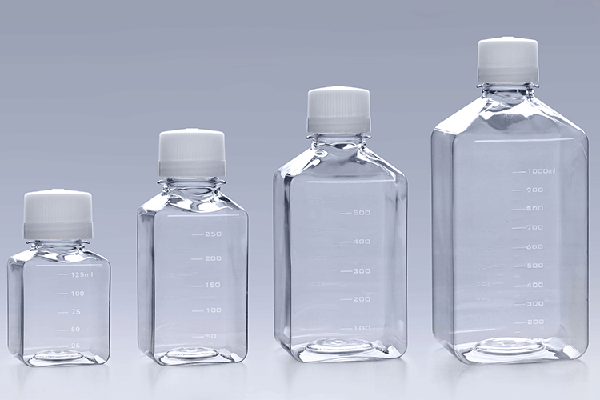
PETG Media Bottles Procurement Guide
1. Specialized Materials: Stability at -80°C
PET (polyethylene terephthalate) and PETG (glycol-modified PET) materials provide exceptional low-temperature adaptability. In the extreme environment of ultra-low-temperature freezers (-80°C), ordinary containers may become brittle or deformed. However, PET and PETG media bottles maintain superior flexibility and mechanical strength due to their unique molecular structure, ensuring no cracks or leaks during long-term cryogenic storage. Additionally, PETG offers higher transparency and lower water absorption than PET, allowing clearer sample observation while minimizing moisture interference.
2. Size Variations: Adapting to Diverse Experimental Needs
PETG media bottles are designed in various sizes to accommodate different experimental scales. For preliminary cell culture tests, researchers often use small-capacity bottles (25mL or 50mL) with narrow necks for precise pipetting and aseptic handling. In industrial-scale production, larger bottles (1000mL+) with wide openings and rapid-pour designs significantly improve liquid transfer efficiency.
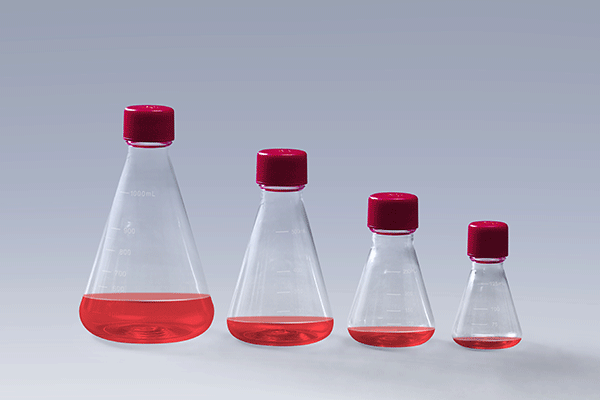
3. Functional Innovations: Smart Solutions for Experimental Challenges
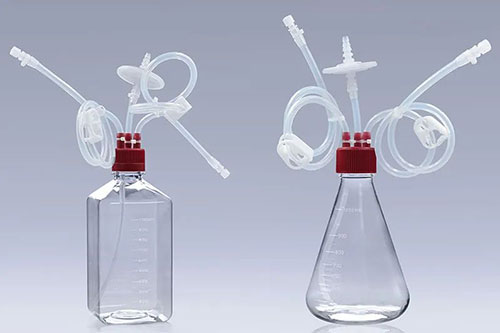
To address real-world experimental challenges, PET and PETG media bottles continue to evolve. For liquid transfer, they can be paired with two-way or three-way tubing systems to ensure sterile handling.
Two-way tubing simplifies unidirectional transfer, ideal for moving serum into culture dishes with minimal exposure.
Three-way tubing offers greater flexibility, enabling multi-container connections for reagent mixing or sequential transfers—eliminating contamination risks from repeated connections.
4. Customization: Tailored Solutions for Unique Needs
Suppliers provide customized PETG media bottles to meet specialized requirements, from branded logos to bespoke port designs, ensuring seamless integration with advanced experimental workflows.
As life science research advances, PETG media bottles are transitioning from standardized containers to specialized tools. Every material choice, size adaptation, and functional enhancement reflects a deep understanding of experimental needs. These seemingly minor refinements play a crucial role in scientific progress, making PETG media bottles an indispensable "unsung hero" in the lab.










