For a multilayer Cell Factory, total culture area is easy to compare. Surface consistency is much harder to see—but it can directly affect how evenly cells attach and grow across different layers.
Two Cell Factories may have the same number of layers and similar specifications, yet differences in surface flatness, TC treatment, or layer-to-layer uniformity may lead to different culture performance.
So, how can users evaluate Cell Factory surface consistency when qualifying a new product or supplier?
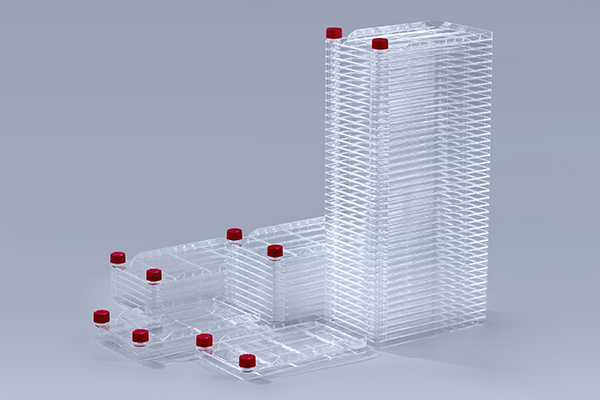
Cell Seeding Density and Medium Volume Guide
1. Start With Surface Flatness
The first check is the physical condition of the culture surface.
Each layer should remain sufficiently flat and stable so that culture medium can distribute evenly across the surface during seeding and incubation.
Uneven surfaces, deformation, or local distortion may influence liquid distribution and contribute to differences in cell attachment.
For multilayer products, evaluation should not focus only on the top or bottom layer. Consistency between layers is equally important.
2. Evaluate TC Treatment Uniformity
For adherent cell culture, the culture surface is normally treated to improve wettability and support cell attachment.
A useful Cell Factory evaluation therefore needs to consider not only whether the product is TC-treated, but also whether the treatment is uniform across:
Different positions on the same layer
Different layers within one Cell Factory
Different products within the same batch
Different production batches
If surface treatment varies significantly, cell attachment and spreading may also become less uniform.
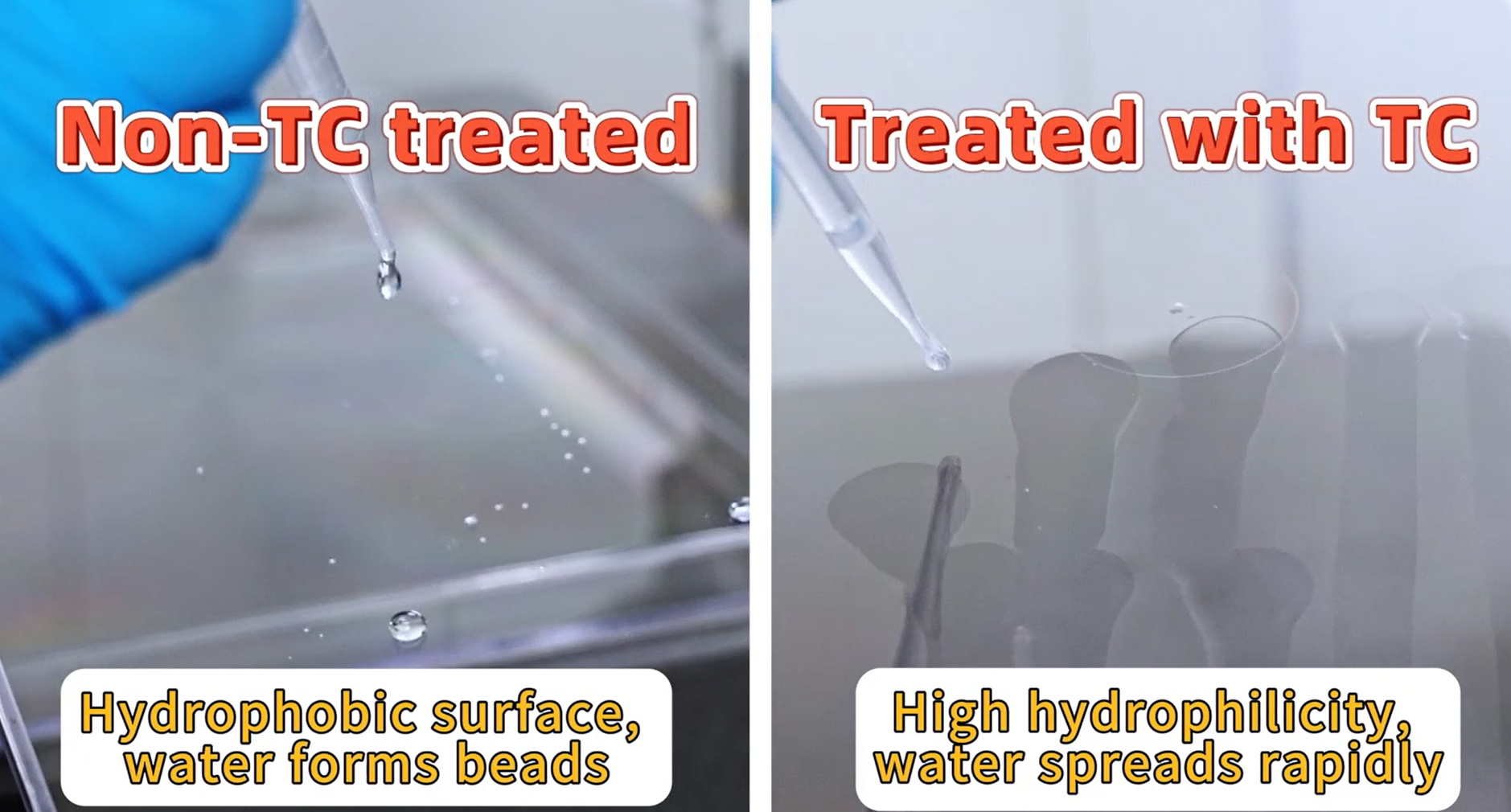
TC Treatment of Cell Factory Culture Surface
3. Use Wettability as an Indicator
Surface wettability can provide an indirect indication of TC treatment consistency.
One commonly used method is contact angle measurement. By comparing measurements at multiple positions, manufacturers can evaluate whether surface treatment remains reasonably uniform across the culture area.
For supplier qualification, the important point is not simply one contact-angle value.
More useful questions include:
Are measurements taken at multiple points?
Is variation between positions controlled?
Is consistency monitored between production batches?
Are testing methods standardized?
This provides more meaningful information than evaluating a single sample point.
4. Compare Cell Attachment Across Different Areas
Ultimately, physical and surface measurements should correspond with actual cell culture performance.
A practical assessment can compare cell attachment at different positions after seeding.
For example, users can examine:
center vs. edge areas
and, in a multilayer Cell Factory:
upper layers vs. middle layers vs. lower layers
The objective is not to expect every microscopic field to look identical, but to check whether obvious systematic differences appear across the culture surface.
Large differences may indicate that seeding technique, liquid distribution, surface properties, or product structure should be investigated further.If uneven attachment has already appeared during culture, see Avoiding Uneven Cell Attachment in Multilayer Cell Factories for additional troubleshooting factors.
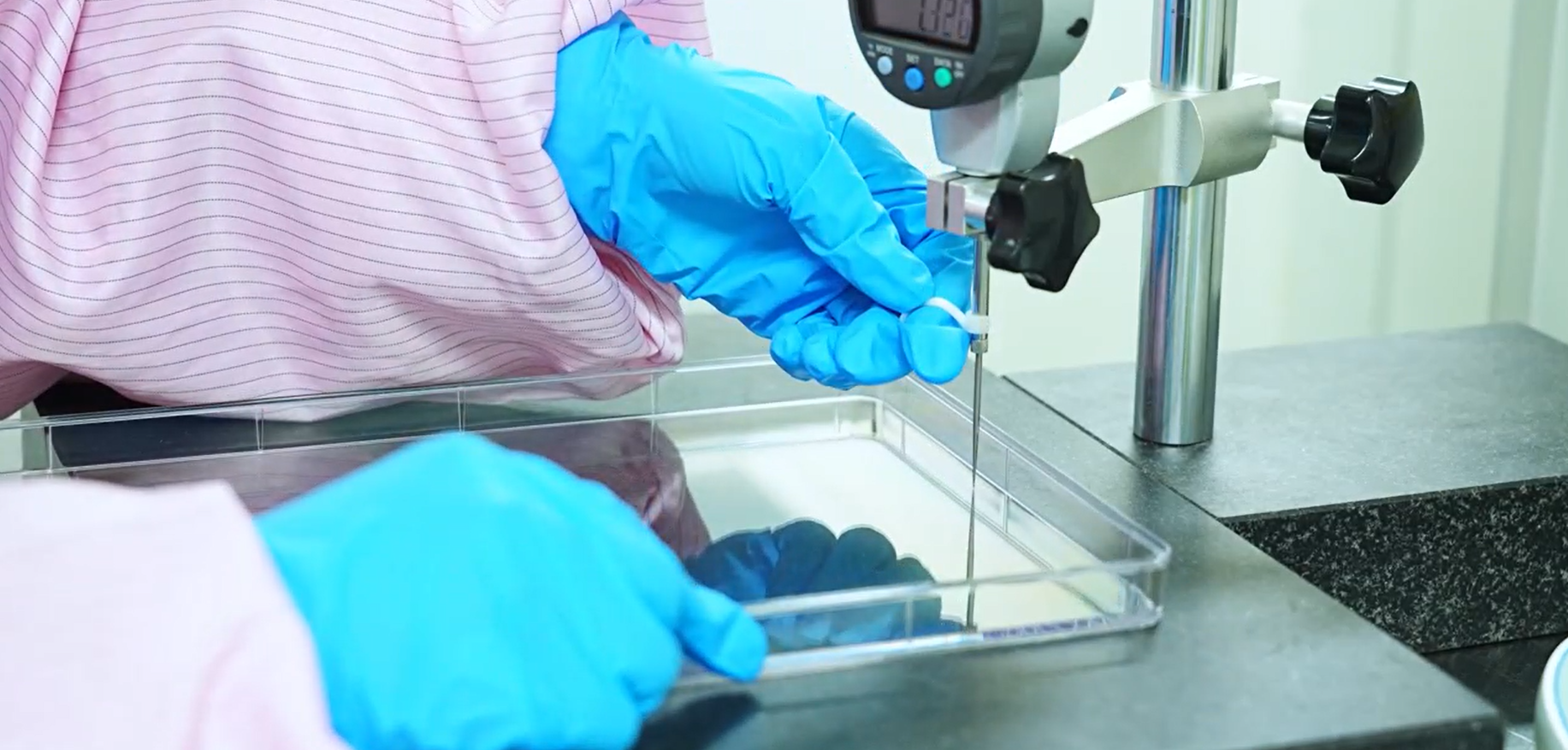
Cell Factory Surface Flatness Inspection
5. Look Beyond Initial Attachment
Initial cell attachment is only one part of the evaluation.
Surface inconsistency may also become more visible during continued culture. Therefore, qualification testing can also observe:
Cell morphology
Cell spreading
Confluence development
Growth uniformity
Areas of unusually low cell density
If the same low-growth areas repeatedly appear at particular positions or layers, further investigation may be necessary.
6. Compare Layer-to-Layer Consistency
This is especially important for multilayer Cell Factory systems.
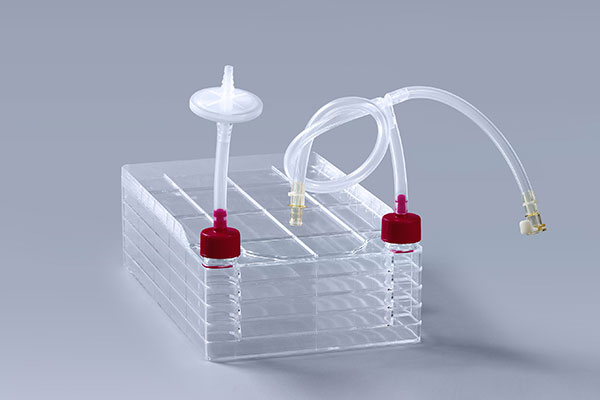
A 10-layer or 40-layer Cell Factory should not be evaluated simply as one large culture vessel. Each layer contributes to the final culture result.
During qualification, users should consider whether:
different layers show comparable medium distribution, cell attachment, and growth performance.
Layer-to-layer consistency becomes increasingly important as the number of culture layers increases.
7. Do Not Ignore Batch-to-Batch Consistency
A good sample does not automatically mean a stable product.
For biopharmaceutical and vaccine applications, repeated performance across production batches is often more important than one successful evaluation.
When evaluating a Cell Factory manufacturer, customers can therefore ask about:
Surface treatment controls
Flatness inspection
In-process quality checks
Batch release criteria
Batch traceability
Retained samples
Historical consistency data
These factors help determine whether surface performance can remain stable during long-term supply.
Surface Consistency Is More Than One Test
There is no single measurement that fully represents Cell Factory surface consistency.
A more complete evaluation combines:
Physical flatness
TC treatment uniformity
Wettability
Cell attachment
Layer-to-layer comparison
Batch-to-batch consistency
Together, these factors provide a more realistic picture of how a Cell Factory may perform in actual cell culture.
For customers qualifying a new supplier, surface consistency should therefore be evaluated as part of the overall product and process assessment—not simply by looking at total culture area or layer number.
FDCELL provides 1-, 2-, 5-, 10-, and 40-layer Cell Factory products for different cell culture scales, with attention to product consistency, surface treatment, quality control, and batch traceability.These controls form part of a broader quality and compliance framework for cell culture consumables.










