Medium exchange is one of the most important steps in Cell Factory culture. An effective medium replacement strategy helps maintain nutrient levels, remove metabolic waste and support healthy cell growth throughout the culture process.
Whether you are expanding Vero, HEK293, CHO or other adherent cells, optimizing medium exchange can improve cell viability, process consistency and production efficiency.
This guide outlines practical considerations for optimizing medium exchange in Cell Factory applications.

Cell Seeding Density and Medium Volume Guide
Why Medium Exchange Matters
As adherent cells grow, nutrients are gradually depleted while metabolites such as lactate and ammonia accumulate. Without timely medium replacement, cell growth may slow and product quality can be affected.
A well-planned medium exchange helps to:
Maintain nutrient availability
Remove metabolic waste
Support stable pH conditions
Improve cell viability
Increase batch consistency
For large-scale production, an optimized medium exchange strategy is essential for reproducible Cell Factory culture.
Choose the Right Medium Exchange Schedule
There is no universal schedule for every cell line. The optimal frequency depends on factors such as:
Cell type
Seeding density
Culture duration
Medium formulation
Production objective
Instead of relying on a fixed timetable, monitor cell morphology, confluence and metabolite levels to determine the appropriate timing.
Overly frequent medium changes may increase operating costs, while delayed replacement can negatively affect cell health.
Minimize Disturbance During Medium Replacement
Adherent cells require stable attachment to the culture surface.
During medium exchange, unnecessary movement or excessive flow rates may disturb the cell layer.
To minimize disruption:
Transfer media slowly and steadily.
Avoid introducing air bubbles.
Keep the Cell Factory level during filling and draining.
Prevent sudden pressure changes.
Gentle handling helps preserve uniform cell distribution across all culture layers.
Consider Closed-System Medium Exchange
Many biopharmaceutical manufacturers now prefer Closed System Cell Factory workflows.
By integrating sterile tubing assemblies, medium bags and compatible connectors, closed systems reduce manual handling while helping maintain aseptic conditions.
Benefits include:
Reduced contamination risk
Consistent fluid transfer
Improved operator safety
Simplified scale-up
Better process reproducibility
For GMP manufacturing, closed-system medium exchange has become a common approach.
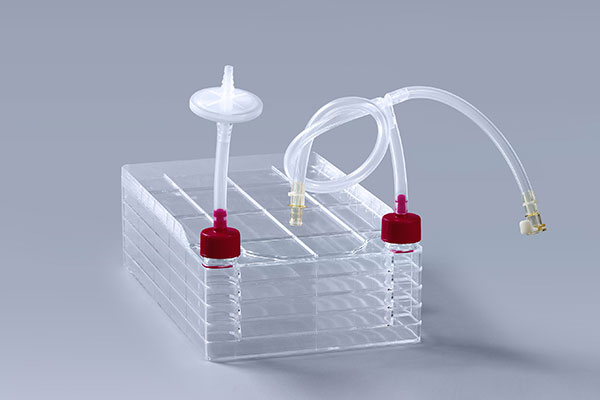
Closed System Cell Factory
Ensure Uniform Media Distribution
One challenge in multilayer Cell Factory culture is achieving even media distribution across every layer.
Uneven filling may result in:
Variable nutrient availability
Inconsistent cell growth
Differences in confluence between layers
Using properly designed tubing assemblies and following standardized filling procedures can help maintain uniform conditions throughout the culture vessel.
Standardize Your Workflow
As production scales up, standardized procedures become increasingly important.
Consider documenting:
Media preparation
Exchange intervals
Transfer speed
Temperature control
Operator procedures
Equipment settings
A standardized workflow improves batch-to-batch consistency and simplifies process validation.
Select High-Quality Cell Factory Systems
Even the best medium exchange protocol cannot compensate for poor product quality.
When selecting a Cell Factory, evaluate factors such as:
Surface consistency
Leak resistance
Sterility assurance
Batch traceability
Compatibility with closed-system tubing assemblies
Reliable manufacturing quality contributes to stable cell culture performance over multiple production batches.
Why Choose FDCELL Cell Factory?
FDCELL supplies Cell Factory systems in 1-layer, 2-layer, 5-layer, 10-layer and 40-layer configurations for laboratory research and commercial manufacturing.
Our solutions feature:
TC-treated growth surfaces
Closed-system tubing assembly options
Multiple cap configurations
Sterile manufacturing
Batch traceability
OEM and customized solutions
These features help support efficient medium exchange and consistent large-scale adherent cell culture.
Conclusion
Optimizing medium exchange in Cell Factory culture is an important step toward improving cell growth, maintaining product quality and achieving consistent manufacturing results.
By selecting appropriate exchange schedules, minimizing disturbance, adopting closed-system workflows and standardizing operating procedures, manufacturers can improve process reliability while supporting scalable biopharmaceutical production.










