Filling a Cell Factory may look straightforward, but as the number of layers increases, small handling differences can affect liquid distribution, cell seeding and subsequent culture consistency.
Compared with a conventional T-flask, a multilayer Cell Factory requires the culture medium or cell suspension to move through multiple interconnected layers. Filling too quickly, introducing excessive air or using an inconsistent distribution procedure may contribute to bubbles, uneven cell attachment or differences between layers.
Here are some common mistakes to avoid when filling a Cell Factory.

Cell Seeding Density and Medium Volume Guide
1. Filling Too Quickly
One of the most common mistakes is transferring medium or cell suspension too quickly.
High flow rates can increase turbulence and foaming as liquid enters the Cell Factory. This may introduce unwanted bubbles and make uniform distribution more difficult.
Instead, fluid should be transferred at a controlled rate appropriate for the Cell Factory configuration, tubing assembly and transfer method.
When using a peristaltic pump, the operating conditions should be established according to the specific process rather than simply using the highest available speed.
2. Allowing Too Much Air to Enter
A Cell Factory naturally contains a gas phase, but unwanted air introduced into the liquid during filling can create bubbles over the culture surface.
Common sources include:
Air remaining inside transfer tubing
Poorly connected tubing
Empty sections within the fluid path
Excessive agitation of culture medium
Interruptions during transfer
For closed-system workflows, appropriate tubing preparation or priming can help reduce unnecessary air entering the Cell Factory.
3. Ignoring Cell Suspension Uniformity
When filling a Cell Factory for cell seeding, attention should be paid not only to the vessel but also to the cell suspension.
Cells can settle or form aggregates before and during inoculation. If the suspension is not sufficiently uniform, different layers or regions may receive different numbers of cells.
Before inoculation, prepare a homogeneous cell suspension and follow a consistent filling procedure.
This becomes increasingly important when working with larger multilayer Cell Factory systems.
4. Using an Incorrect Filling Volume
The appropriate working volume depends on the Cell Factory configuration, cell line, medium and culture process.
Too little medium may not provide adequate coverage of the culture surface, while an inappropriate excess can affect gas exchange and handling.
Rather than assuming that all multilayer vessels use the same volume per layer, operators should follow the product specifications and establish the appropriate working volume during process development.
5. Using the Wrong Vessel Position
Filling is only one part of the process. The liquid must also be distributed across the individual culture layers.
Incorrect positioning during filling or distribution can cause medium and cells to accumulate unevenly.
The correct procedure depends on the Cell Factory design and layer configuration. Operators should follow the manufacturer's instructions for filling, positioning and liquid distribution.
This is particularly important when scaling from smaller vessels to 10-layer or 40-layer Cell Factory systems.
6. Shaking the Cell Factory Excessively
When operators notice uneven liquid distribution, the instinct may be to shake the vessel.
However, aggressive or unnecessary movement can introduce additional bubbles and disturb the cell suspension.
Controlled positioning and gentle handling are preferable to vigorous shaking.
After cell distribution is complete, unnecessary movement should also be minimized so that cells can begin attaching uniformly to the culture surface.
7. Overlooking the Tubing Assembly
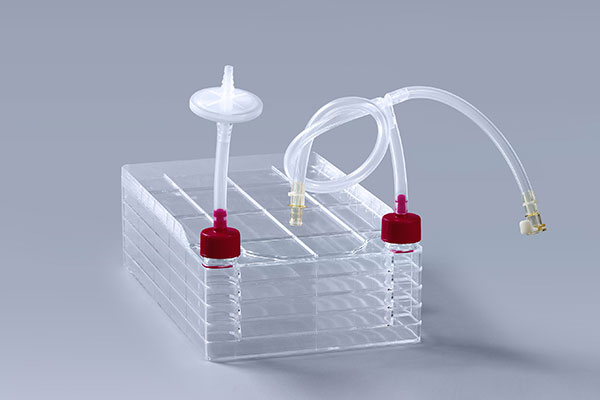
In a Closed System Cell Factory, the tubing assembly is part of the filling process.
Tubing diameter, material, connector configuration, pump compatibility and trapped air can all influence fluid transfer.
Before filling, check:
Tubing connections
Clamps
Connectors
Media bag connections
Pump installation
Fluid path integrity
A properly configured tubing assembly can help make media filling and cell inoculation more consistent.
8. Failing to Check for Bubbles
After filling and liquid distribution, visible bubbles should not simply be ignored.
Bubbles trapped over the culture surface can prevent medium and cells from contacting localized areas, potentially contributing to uneven cell attachment.
The Cell Factory should therefore be inspected according to the established operating procedure before incubation.
If unwanted bubbles are present, follow the validated handling procedure for the specific vessel to redistribute the liquid appropriately.
Related Article: How to Reduce Bubble Formation in Cell Factory Culture
9. Moving the Vessel Too Much After Seeding
Once cells have been distributed across the culture surface, excessive movement may cause cells to shift before stable attachment occurs.
This can contribute to uneven distribution or accumulation in certain areas.
After completing the required distribution procedure, transfer the Cell Factory carefully to the incubator and maintain the appropriate culture position.
Related Article: Avoiding Uneven Cell Attachment in Multilayer Cell Factories
10. Relying on Operator Experience Without a Standard Procedure
Experienced operators may develop their own methods for filling and handling Cell Factory systems.
However, when multiple operators or production batches are involved, small differences in technique can introduce process variability.
A standardized filling procedure should define relevant parameters such as:
Fluid preparation
Transfer method
Filling sequence
Vessel positioning
Cell distribution procedure
Bubble inspection
Transfer to incubation
Standardization becomes increasingly important as Cell Factory culture moves from laboratory development to routine manufacturing.
Filling Cell Factories During Scale-Up
The larger the Cell Factory configuration, the more important fluid handling becomes.
A procedure developed with a small vessel should not automatically be assumed to perform identically in a larger multilayer system.
During scale-up, manufacturers should evaluate whether changes are required in fluid transfer, tubing configuration, vessel handling and cell distribution.
Closed-system tubing assemblies can also help standardize media transfer and inoculation while reducing repeated manual operations.
FDCELL Cell Factory Systems
FDCELL provides Cell Factory systems for scalable adherent cell culture in 1-layer, 2-layer, 5-layer, 10-layer and 40-layer configurations.
Available options include TC-treated culture surfaces and customized closed-system tubing assemblies for media filling, cell inoculation, medium exchange and harvesting.
FDCELL Cell Factory systems are designed for applications including vaccine manufacturing, viral vector production, biopharmaceutical research and other large-scale adherent cell culture processes.
Conclusion
Many problems encountered during Cell Factory culture can begin during the filling and seeding process.
Filling too quickly, introducing excessive air, using an uneven cell suspension, incorrect positioning and excessive vessel movement can all affect subsequent culture performance.
A controlled and standardized Cell Factory filling procedure can help improve liquid distribution, reduce bubble formation and support more uniform cell attachment—especially as adherent cell culture moves toward larger-scale production.










